
Bed Slat Spacing: How to Check Your Mattress Support Requirements
Before replacing your mattress, check the clear gaps, slat width, center support, and condition of the bed beneath it. Manufacturer requirements differ.
Table of contents
Measure clear gaps and slat width separatelyCompare the requirements for your actual mattressCheck the center support and the condition of the whole frameWork through a frame check without declaring it approved too soonAsk about an approved correction before adding boards or slatsPrepare a useful support-check request
The right bed slat spacing is the spacing your particular mattress manufacturer allows, together with the required slat width and support structure. Measure the clear gap between adjacent slats, inspect the widest gaps, and check the center beam and floor supports. A frame that held your old mattress may not meet the new mattress’s requirements. Use the exact model’s current guidance instead of one universal gap rule.
Measure clear gaps and slat width separately
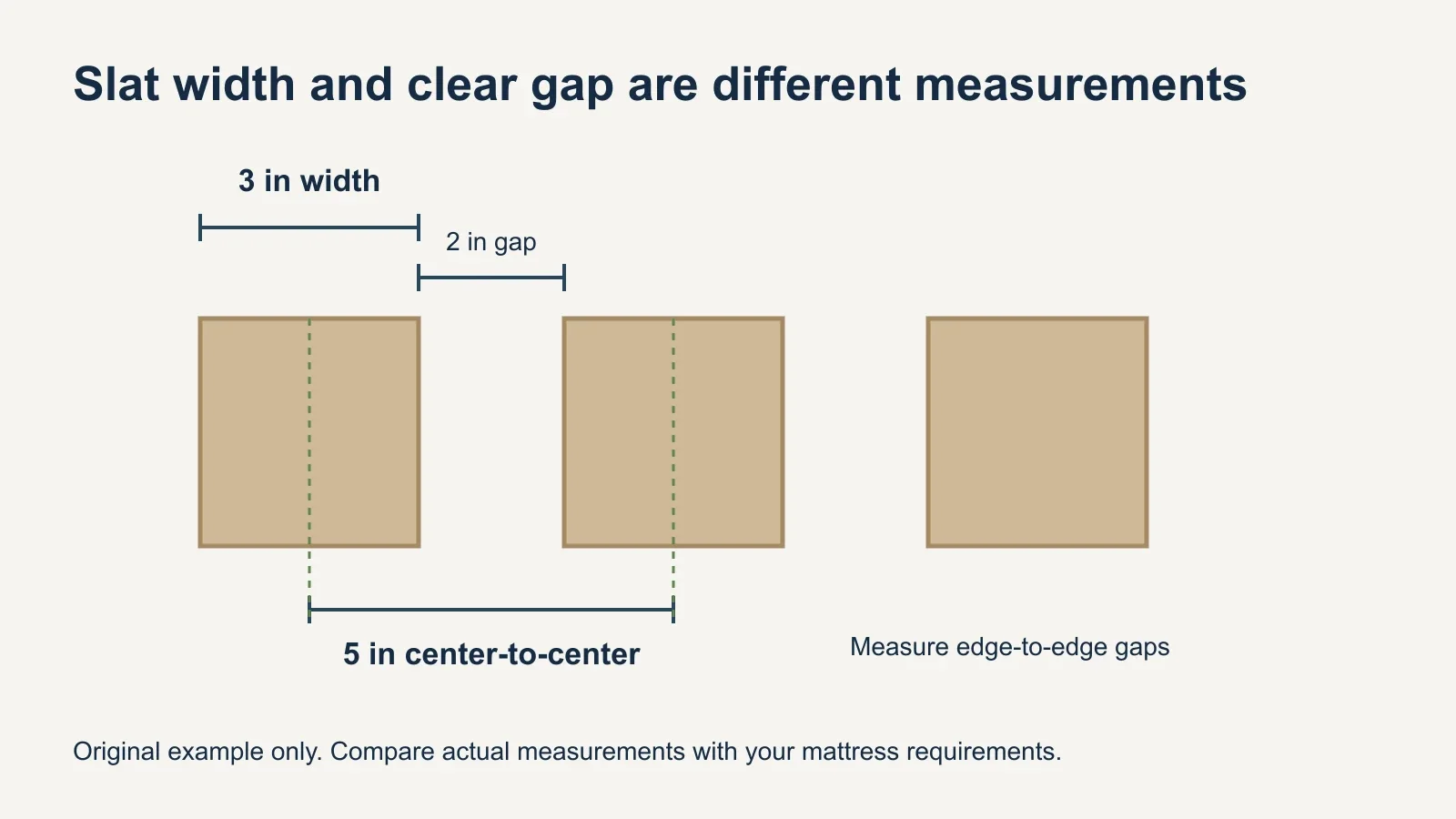
Slat width is the width of the supporting strip itself. Clear spacing is the empty distance from the edge of one slat to the nearest edge of the next. Center-to-center spacing includes part of each slat and is a different measurement. If a furniture specification only says “spacing,” ask which reference points it uses before comparing it with a mattress requirement.
For example, a hypothetical base with 3-inch-wide slats and 2-inch clear gaps has a 5-inch center-to-center repeat distance. Calling that a 5-inch gap would misdescribe the support. Conversely, subtracting a slat width from a measurement already taken between edges would make the gaps appear smaller than they really are.
Follow the mattress maker’s handling instructions when exposing the support surface and get help if the mattress is heavy or awkward. With the mattress safely out of the way, measure more than one gap. Include the head and foot ends and any unusually wide opening. If straps or holders locate the slats, check the measurements in their correctly installed positions.
Write down the narrowest slat width and largest clear gap, not just an average. Note slat thickness, material, length, and whether the strips are flat or intentionally bowed. A gap measurement alone does not describe how the slat is supported or whether its construction is suitable for the intended mattress.
Compare the requirements for your actual mattress
The table below summarizes selected US manufacturer guidance checked on October 24, 2026. It is a starting point for a model-specific check. Product generations, sizes, special constructions, and the support system used can change what applies. The source names identify which manufacturer document to request; no row is a universal rule for mattresses of a similar material.
| Manufacturer and document | Slat guidance in that document | Other conditions to verify |
|---|---|---|
| Tempur-Pedic — current-frame and platform-bed help pages | Slats at least 3 inches wide; spacing no more than 4 inches | Structurally sound support and sturdy center support; confirm the exact mattress and frame |
| Purple — Mattress Limited Warranty, Frame/Foundation Requirements | Slats no more than 3½ inches apart when used without an additional foundation | Sturdy frame and center support; stated leg counts are 5–6 for Queen/King/Cal King and 4 for Twin/Full; read size/model conditions |
| Casper — FAQ, compatible bed frames | Flat wooden slats, not bowed; gaps no more than 4 inches | Firm support; obtain any model-specific width, center-support, and frame requirements separately |
Notice that the table includes both dimensions and construction. A gap that falls within a listed limit does not resolve a missing center support, a cracked slat, or a requirement for flat wooden strips. If a dimension is absent from a general FAQ, that means you still need the relevant product guidance; it does not mean the dimension is unrestricted.
Tempur-Pedic also has a general support page whose wording says gaps should be less than 4 inches, while the two help pages summarized above say no more than 4 inches. If your frame is at that boundary, ask Tempur-Pedic to confirm the requirement for your specific mattress and purchase documentation. Do not round down a measurement or select the more permissive wording to settle a conflicting instruction.
Save the model name, size, purchase date, applicable care instructions, and the manufacturer’s response. Support conditions can matter to both product performance and warranty assessment. A retailer’s broad “works with most mattresses” description is less useful than a clear answer about your photographed frame and exact measurements.
Check the center support and the condition of the whole frame
Look at how loads reach the floor. Cross slats may rest on the side rails and on a beam running from head to foot. That beam may require its own floor-contact legs. Confirm the arrangement against the frame instructions and the mattress requirements. A rail suspended between the ends of the bed is not automatically equivalent to a center beam supported by legs.
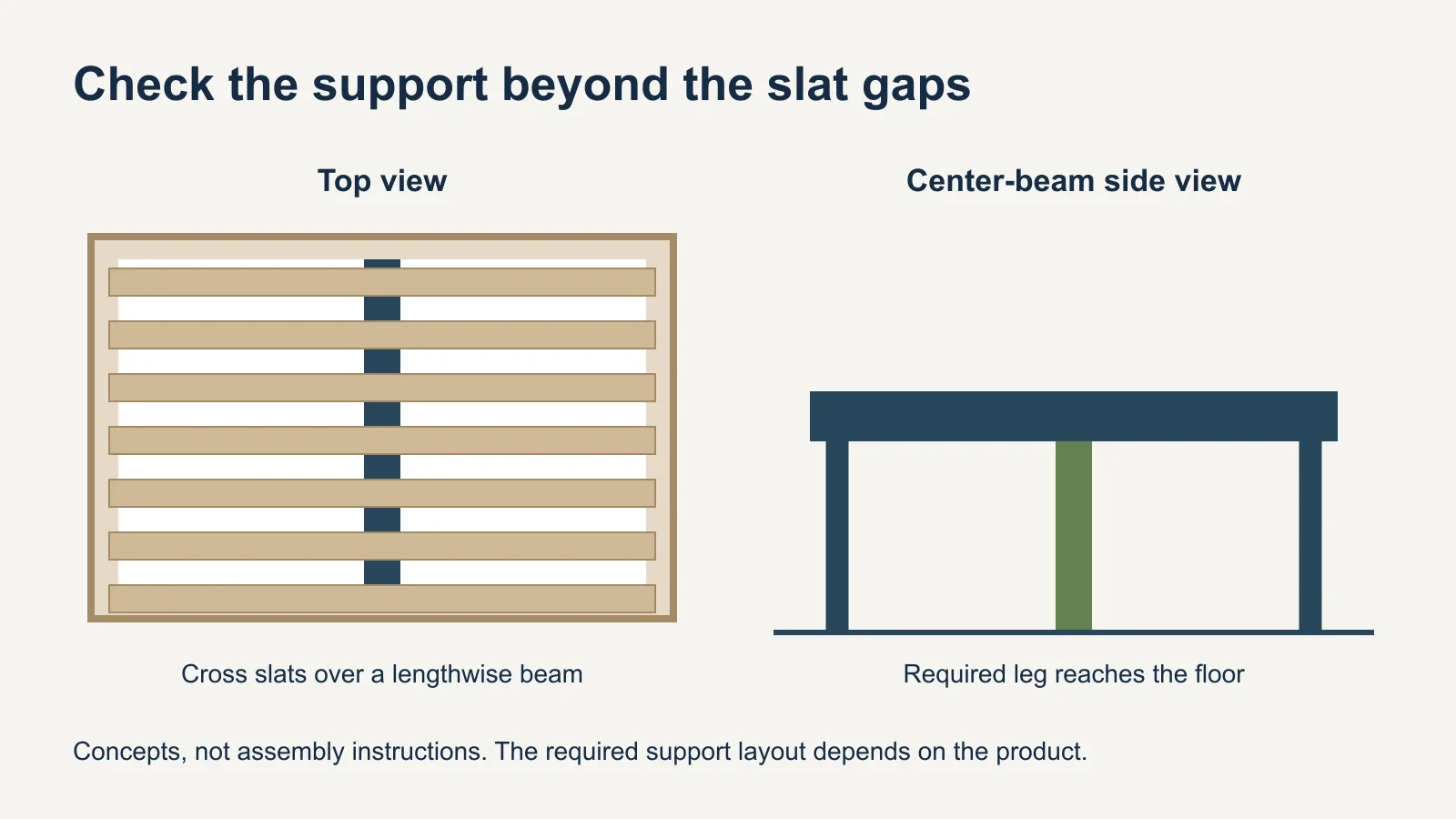
Check whether the required legs contact the finished floor as intended. A center leg left above the floor cannot provide its intended support. An adjustable foot that has shifted after the bed was moved also needs attention. Follow the frame’s leveling and tightening procedure; do not wedge random objects beneath the beam or assume that more improvised legs will correct a damaged structure.
Inspect slat ends and their seats or holders. Look for cracks, missing pieces, loose connections, distorted rails, damaged brackets, or slats that no longer remain in their intended position. Pay attention to changes since a move or disassembly. If a support is damaged or unstable, resolve that condition before putting the new mattress into service.
Some slat systems are designed to flex or curve. Others are flat. Do not diagnose every intentional curve as damage, and do not assume that a flexible system suits every mattress. Identify the slat set first, then compare its design with the mattress instructions. Our LURÖY and LÖNSET comparison covers that separate choice for IKEA bed systems.
Work through a frame check without declaring it approved too soon
Consider a hypothetical frame with 2½-inch-wide flat wood slats and a largest clear gap of 3¾ inches. Comparing only that gap with a 4-inch limit might suggest that the frame is acceptable. However, it would not meet the 3-inch width requirement in the Tempur-Pedic help pages summarized above. The width check changes the result even though the gap comparison passes.
Against Purple’s listed 3½-inch spacing limit, the same 3¾-inch gap is ¼ inch too wide. Against Casper’s general FAQ, the gap and flat-wood construction fit the summarized guidance, but you would still need to check the rest of the support system and any specific mattress requirements. These are comparisons with individual criteria, not approvals of the example frame.
This approach also helps you avoid unnecessary purchases. If the frame is intact but a specified component was omitted during assembly, the appropriate solution may be restoring that component. If the slat system is incompatible with the new mattress, tightening screws will not change the gap or material. Identify the failed criterion before deciding whether to repair, replace, or use a different approved support.
Ask about an approved correction before adding boards or slats
Possible solutions can include a manufacturer-approved replacement slat set, an appropriate foundation that the frame is designed to carry, or a different frame. Each changes more than appearance. A replacement must fit the rail seats and intended retention system; a foundation changes finished height and the way the mattress is supported. Confirm both the furniture and mattress requirements.
Do not treat a sheet of plywood or a bunkie board as a universal fix. Tempur-Pedic’s separate support FAQ specifically advises against plywood and bunkie boards for its mattresses. Other products can have different instructions. Ask about the precise material and support arrangement rather than assuming that covering the gaps automatically creates an approved surface.
Adding loose strips between existing slats is also a design change. They need adequate end support, secure positioning, suitable dimensions, and compatibility with the frame. A loose board that can slide out of place does not give dependable support. Obtain an approved replacement or repair method instead of solving one measurement while creating another problem.
Prepare a useful support-check request
- Exact mattress model, size, and purchase or planned purchase date.
- Bed frame and slat-set model numbers, if available.
- Photos of the complete support surface and close-ups of the largest gaps.
- Slat width, thickness, material, shape, and largest clear edge-to-edge spacing.
- Photos showing side-rail seats, center beam connections, and every required floor support.
- Details of damage, missing components, floor unevenness, or changes after moving.
- The proposed replacement part or foundation, if you are considering one.
Ask the mattress manufacturer whether that specific arrangement meets its requirements and ask the frame manufacturer how any required change should be made. Keep the answers with the instructions. A clear photo of a tape measure across a gap is useful, but pair it with a wider photo so the reviewer can understand where the measurement was taken.
If the frame needs reassembly or an approved replacement part, share that information when arranging bed assembly. Explain what has been confirmed and what remains unresolved. Checking the support before the new mattress arrives helps you choose a compatible setup rather than using the mattress itself to test a questionable base.