
Can You Install a Gazebo on a Concrete Patio?
An existing concrete patio may work for a gazebo, but its condition, construction and available anchor locations need checking before assembly.
Table of contents
Start with the existing slab, not the drill bitCheck anchor locations as well as the gazebo footprintChoose the attachment for the concrete you haveFor new concrete, separate setting from readinessResolve slope, water and surface finishesInclude the concrete review in your booking plan
Yes, an existing concrete patio can be a suitable location for a gazebo when the slab and attachment meet the requirements of the purchased kit. Yardistry, for example, provides post mounts for installation on suitable wood or concrete surfaces. The important step is checking the actual slab—not assuming that any hard, flat patio is ready for anchors.
Before assembly, establish the proposed post positions, what is known about the concrete and who will confirm the attachment details. A patio with unknown construction is a question to resolve, not necessarily a reason to replace everything. The checks below help organize that review without prescribing one anchor or slab thickness for every gazebo.
Start with the existing slab, not the drill bit
Look for plans, contractor records or other information about how the patio was constructed. Useful details include slab thickness, concrete specifications, reinforcement, age and any later repairs or overlays. Tell the installer when those details are unknown. A surface photograph cannot establish everything below the finish.
| Check | Information to provide | Question it helps answer |
|---|---|---|
| Slab construction | Plans, specifications and known repairs or toppings. | Does the concrete suit the proposed support and anchoring? |
| Visible condition | Photos of cracks, damaged edges, spalling or settlement. | Does the site need further assessment or repair first? |
| Post and anchor positions | Exact model drawing and proposed orientation. | Can the required connections fit at suitable locations? |
| Embedded items | Known reinforcement, utilities or post-tensioning. | What investigation and drilling controls are needed? |
| New concrete | Mix information, pour date and contractor’s readiness confirmation. | When can the planned attachment and loading proceed? |
Mark visible issues on a simple patio sketch so they can be compared with the proposed posts. Include joints and edges as well as cracks. Do not diagnose a crack as harmless—or conclude that the whole slab is unusable—from a photograph alone. The question is whether the proposed installation is suitable at the actual connection locations.
Check anchor locations as well as the gazebo footprint
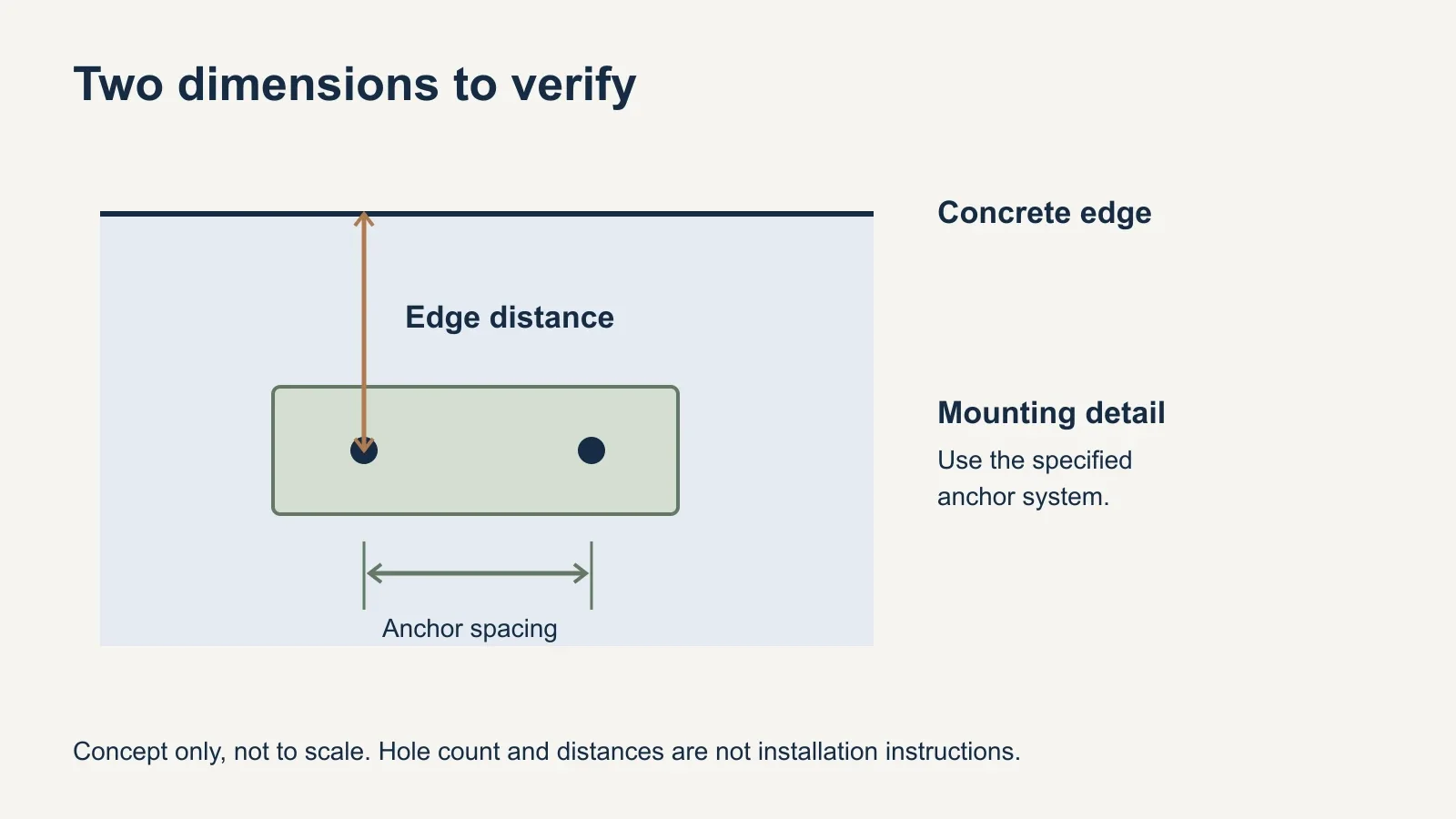
A gazebo may physically fit on the patio while leaving its anchor holes too close to an edge for the selected connection. Simpson Strong-Tie’s comparison of screw and expansion anchors shows that edge-distance and spacing requirements vary with the anchor type and design conditions. There is no single distance from the patio edge that this article can approve for every kit.
Use the mounting pattern and the outside-post dimensions from the correct manual. Have the responsible installer or designer compare them with the usable concrete area. Check the roof overhang separately so nearby walls, fences and other obstacles are considered at the same time.
If a proposed location does not work, review alternatives before drilling: a different orientation, a different kit or appropriately designed foundation work may be worth discussing. Do not move holes within a bracket or add an improvised extension simply to make the original layout fit.
Choose the attachment for the concrete you have
Ask who will specify the anchors and how the selection relates to the gazebo instructions and slab. Anchor length alone is not a sufficient specification. The selected product has its own requirements for concrete, embedment and installation, and those need to match the project.
Keep the hardware discussion separate from the question of what came in the box. Yardistry’s FAQ distinguishes included post-to-structure hardware from separately purchased permanent-mounting hardware. Check your own kit’s inventory; do not assume a packet of assembly bolts includes everything needed for the site connection.
Raise known embedded utilities, reinforcement or post-tensioning before any drilling. Post-tensioned concrete contains tensioned steel tendons and needs an appropriate specialist review when penetrations are proposed. The Post-Tensioning Institute describes existing-slab openings as work involving structural analysis and planned procedures. A homeowner’s visual check is not a drilling clearance.
For new concrete, separate setting from readiness
New concrete adds a scheduling dependency. Ask the concrete contractor when the particular base is ready for the specified anchoring and gazebo loads. Provide the gazebo and connection requirements before the pour, rather than asking the assembly crew to make an unspecified slab work afterward.
QUIKRETE’s guidance illustrates why a single waiting period is misleading: its products have different setting and strength-development times, and temperature can change when loads may be applied. A mix that has set quickly is not blanket approval to install any anchor immediately. Follow the requirements for the actual concrete and connection.
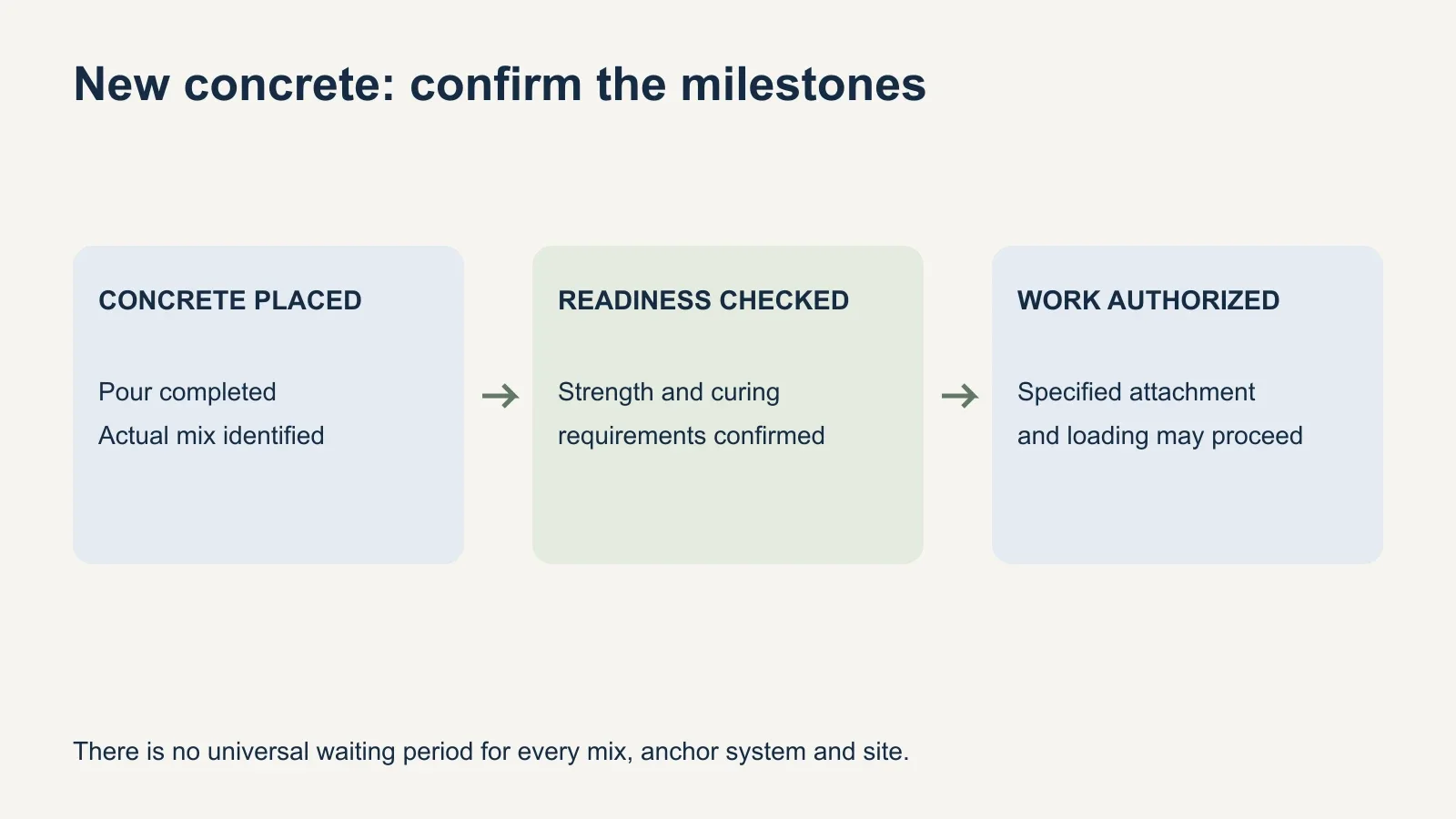
Record who will make the readiness decision and how delays will be communicated. If a repair, additional footing or new pad is needed, let that work determine the assembly date. Keep the kit stored and handled according to its instructions while the base is being prepared.
Resolve slope, water and surface finishes
Tell the installer if the patio slopes, has a textured finish or carries a coating or overlay. The gazebo’s support and leveling requirements still apply. Have any needed correction or bearing detail agreed before the frame goes together; do not force it into alignment with the anchors.
Preserve the site’s drainage plan when considering changes. Ask how rainwater will move around the finished structure and whether a proposed repair changes that path. A surface treatment intended to improve appearance does not automatically establish that the underlying concrete is suitable for anchoring.
- Photograph each intended post location and the whole slab.
- Share any slab records and known embedded services.
- Confirm the model’s post and mounting dimensions.
- Resolve repairs, leveling and drainage details.
- Confirm hardware supply, attachment work and base readiness.
Include the concrete review in your booking plan
Our gazebo anchoring guide explains why permanent attachment remains part of the project even when an assembly quote excludes it. Ask each provider what they cover: evaluating the slab, preparing a new base, assembling the kit and making the permanent connection are distinct responsibilities.
When arranging gazebo assembly with UPTask, send the exact manual, patio photos and available slab information. Confirm the base and anchoring needs before the visit so the appointment is based on a ready site and a clear scope.