IKEA HEMNES Drawers Won’t Open? Safety Locks vs Assembly Problems
A HEMNES drawer that stays shut may be responding to its safety interlock. Learn how to distinguish normal operation from an obstruction or assembly problem.
Table of contents
Start with the exact HEMNES modelUnderstand what the safety interlock doesRead the symptom before changing anythingMake a gentle, limited checkSeparate an assembly issue from a designed stopGive support or an assembler a useful brief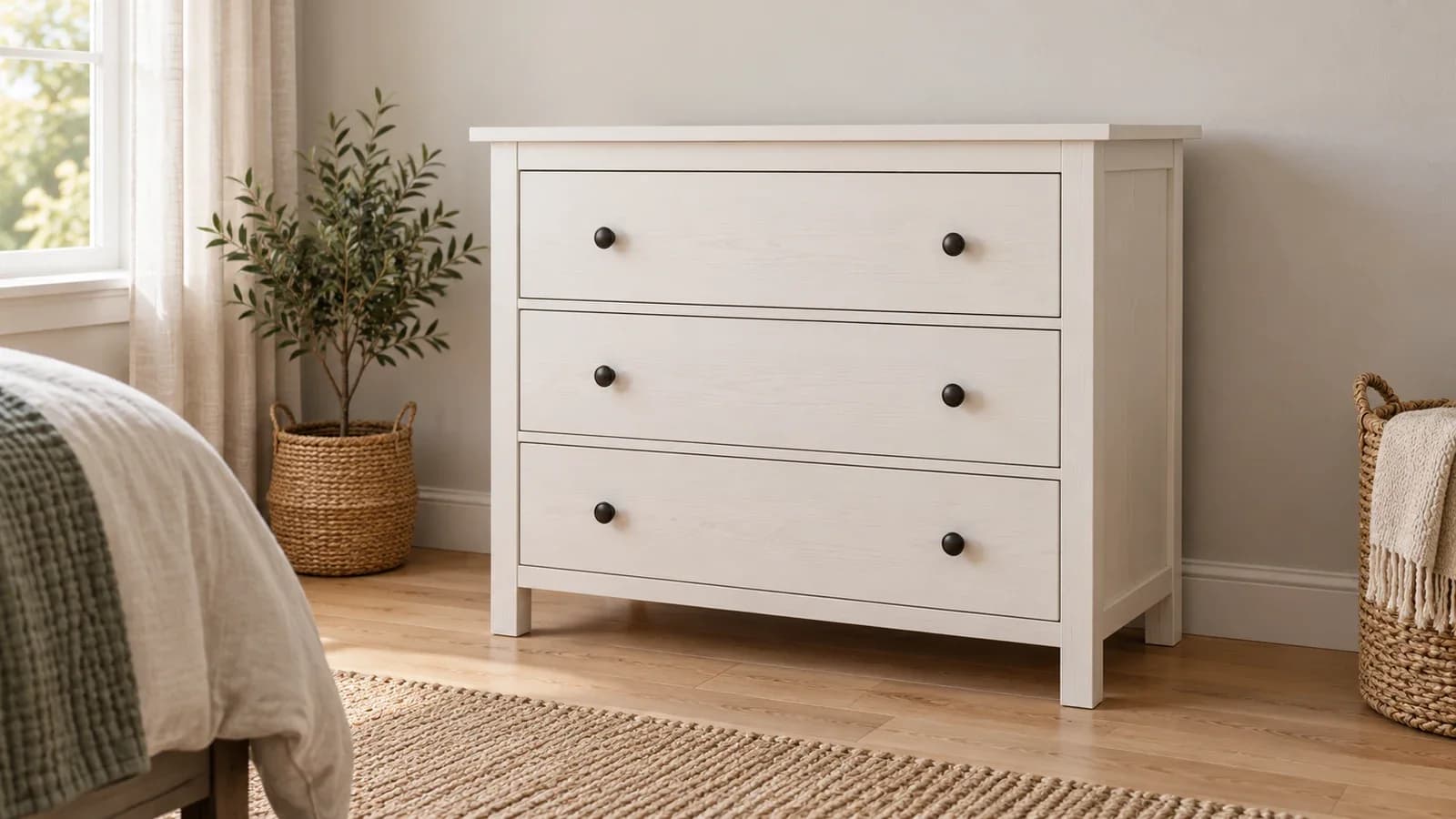
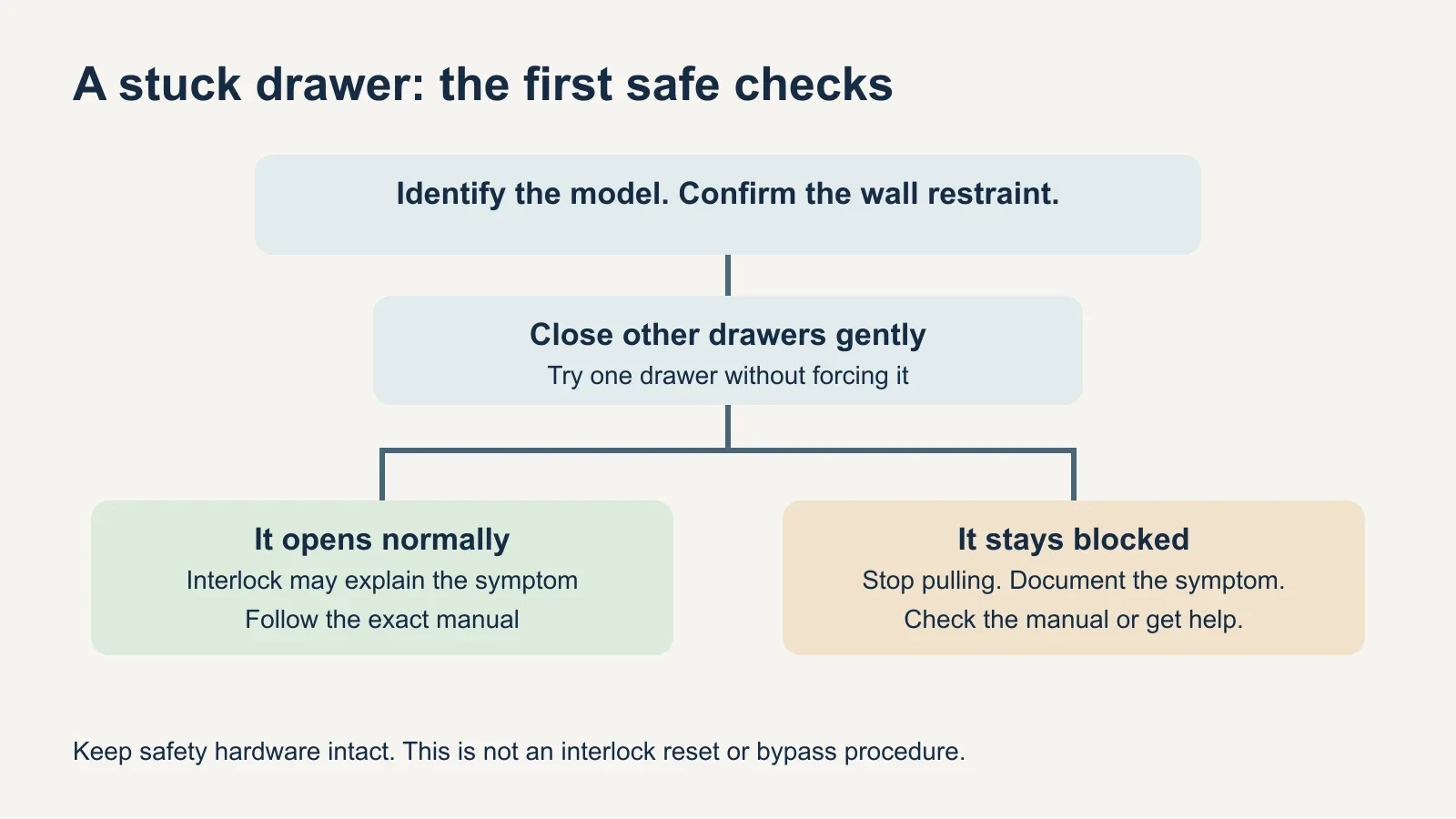
If your IKEA HEMNES drawer will not open, first close every other drawer gently and try one drawer again. On versions with a safety interlock, a drawer left slightly open can prevent another from opening. If the problem continues with all other drawers closed, stop pulling harder: the drawer may be obstructed, incorrectly installed, or affected by a misaligned frame. Identify the exact dresser and its instructions before attempting an adjustment.
Start with the exact HEMNES model
HEMNES is a furniture family, not one unchanging drawer mechanism. A dresser bought years ago, a current U.S. model, and a secondhand piece from another market may have different hardware. Find the product label, article number, and matching assembly manual. Drawer count and color help identify the piece, but they are not enough to choose a repair video or replacement part.
The current U.S. HEMNES eight-drawer dresser includes a drawer interlock and pull-out stops. Its manual warns against defeating or removing the interlock. That means resistance can be intentional, but it does not prove every stuck drawer is operating correctly. Record when the problem started: immediately after assembly, after moving the dresser, or only after filling one drawer. That history makes the next check more useful.
Understand what the safety interlock does
An interlock restricts which drawers can open together. It is different from IKEA’s separate “Anchor and unlock” system used on some other furniture. Do not assume fastening a HEMNES dresser to the wall will release every drawer for simultaneous use. Follow the operating rule in your model’s manual, and keep the interlock intact after anchoring.
Wall attachment remains a separate requirement. A drawer opening normally does not demonstrate that the dresser is safely secured. Complete the specified anti-tip installation with fasteners suitable for the wall, and ask for qualified help if the wall or attachment is uncertain. Our guide to furniture that needs wall anchoring explains what to include in that check.
Read the symptom before changing anything
| What you notice | Possible explanation | Useful next step |
|---|---|---|
| One drawer opens after the others close | Normal interlock behavior may explain it | Continue using one drawer at a time as instructed |
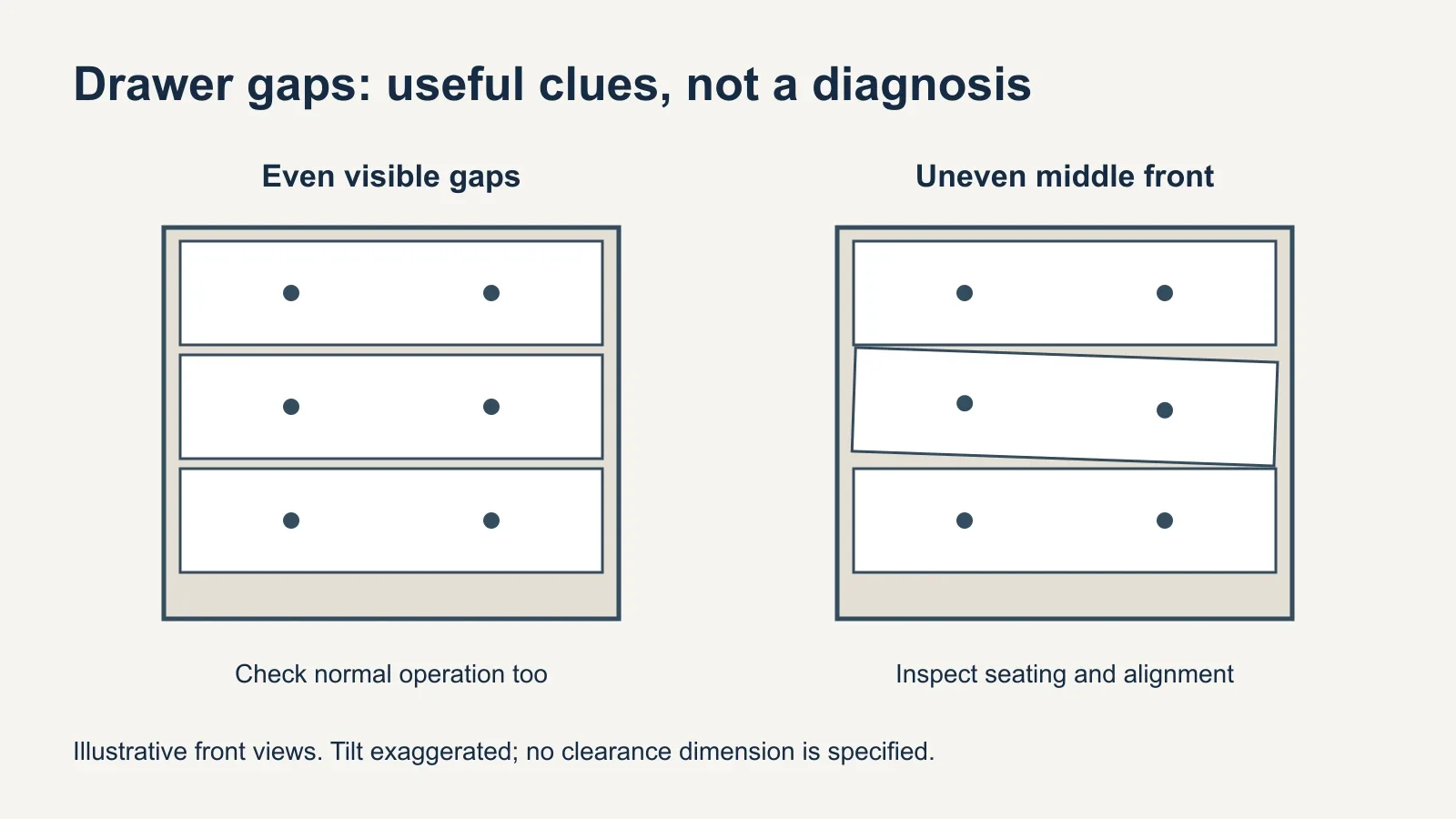
| A drawer front sits proud or rubs on one side | Obstruction, seating, or frame alignment issue | Check the visible gap and matching assembly steps |
| Every drawer remains blocked | Incomplete assembly or a mechanism problem | Stop and document the model and symptom |
| A drawer moves smoothly, then stops evenly | Designed travel limit may explain it | Check the specified pull-out length; do not force farther |
| The problem began after loading or moving | Contents or a change in alignment may be involved | Review accessible contents and the dresser’s position |
These clues are not diagnoses. A rubbing drawer can have more than one cause, and an even-looking front can hide an installation problem. Compare the affected drawer with a working one without opening them together. Notice whether it fails to start moving, stops at one point, or closes but will not sit flush. Describe that behavior instead of reporting only that “the lock is broken.”
Make a gentle, limited check
- Confirm the dresser’s wall attachment is complete and the cabinet is stable before testing normal drawer operation.
- Keep children away from the work area and close other drawers without slamming them.
- Try the affected drawer with an ordinary gentle pull. Stop if it binds, tilts, or requires force.
- If a drawer opens normally, inspect accessible contents for something protruding above or behind the drawer. Do not reach blindly into a trapped mechanism.
- Compare visible front gaps and review the matching drawer, runner, and interlock steps in the manual.
- If the drawer stays blocked or a part appears damaged, stop using it and prepare photos for support or an assembler.
A drawer that is completely jammed may prevent a safe inspection of its contents. Do not pry the front, lever it upward, or pull the dresser away from the wall while it is attached. Removing drawers or dismantling a mechanism can change the cabinet’s stability. Use the model’s documented removal procedure only when appropriate, rather than adapting a trick intended for a different drawer system.
Separate an assembly issue from a designed stop
After a new assembly, an installer should compare left and right components, attachment positions, and drawer seating with the correct manual. The goal is to find a specific mismatch, not to loosen every fastener until the drawer moves. A frame that is not square can also affect clearances. Correcting it may require controlled disassembly and another check of the wall restraint.
Limited extension is a different symptom from a drawer that will not open. Some current dressers deliberately allow less travel than the drawer’s full depth. If movement is smooth and stops at the same point without rubbing, compare it with the product specifications. Do not remove a stop to make the back of the drawer easier to reach.
Avoid adding oil or another lubricant as a first response to an unidentified blockage. It will not correct a reversed component, misplaced attachment, or safety interlock operating as designed. Likewise, replacing a runner based only on its appearance can introduce a mismatch. Establish the model and cause before buying parts or altering the assembly.
Give support or an assembler a useful brief
Take a full front photo with the drawers closed, a close-up of the uneven gap if there is one, and a readable photo of the product label. Add the matching manual page and any loose or visibly damaged part. State whether all drawers are affected, whether the dresser ever worked correctly, and whether the issue appeared after a move. Keep personal order details out of publicly shared pictures.
For hands-on assistance, describe both the drawer issue and the wall attachment when arranging furniture assembly help. A partly assembled dresser, a damaged component, and an operating interlock require different work. Leave the mechanism intact and the affected drawer unloaded where safely accessible until the cause is understood.