How Much Does Furniture Assembly Cost in 2026? Prices by Item & Size
Compare furniture assembly prices by item and configuration, with U.S. budgeting benchmarks and verified UPTask examples for the Bay Area.
Table of contents
What should you budget for furniture assembly?Prices by furniture item and configurationWhy size alone does not determine the priceHourly versus fixed pricing: compare the whole billWhich extra costs should you check?When does DIY assembly make financial sense?Get an accurate quote before assembly day
Furniture assembly can cost around $100–$220 for a typical U.S. project, but a small item and a multi-frame wardrobe need very different budgets. Thumbtack’s March 2026 guide reports a $102–$221 national average range. Below are national benchmarks and specific UPTask examples for the Bay Area.
The useful comparison is your complete assembly price: the exact furniture configuration, billable time or fixed scope, and any separately charged work.
What should you budget for furniture assembly?
Use national figures to set an initial budget, then request a price for the model you bought. Thumbtack reports an average hourly rate of $65, with listed low and high rates of $40 and $100. Those are marketplace benchmarks, not a price list for every U.S. city, and the project range above is not a per-item charge.
Different booking routes also price the work differently. IKEA’s U.S. assembly service through Taskrabbit starts at $52 and uses flat rates based on the selected products. That is an order starting point, not a promise that a large dresser or wardrobe will cost $52.
Prices by furniture item and configuration
A useful price comparison names both the furniture and what comes with it. These examples come from UPTask’s published bed, dresser, and wardrobe service pages. Starting prices apply to the stated base configuration; carrying, additional storage components, and other selected extras can change the total.
| Furniture & configuration | Assembly price | Scope & price notes |
|---|---|---|
| Standard bed | from $69 | For the frame, supports or slats, and ordinary supplied headboard and footboard. |
| Daybed | from $79 | Before optional storage features or a trundle. |
| Bunk bed or loft bed | from $109 | Including the supplied standard ladder and guardrails. |
| Dresser with up to four drawers | $89 | Before optional carrying. |
| Six-drawer dresser | $99 | Calculated as $89 + two additional drawers × $5. |
| Eight-drawer dresser | $109 | Calculated as $89 + four additional drawers × $5. |
| Standard hinged wardrobe with one or two doors | from $89 | Before interior extras. |
| Sliding-door wardrobe with one or two doors | from $109 | Before interior extras. |
| Modular wardrobe | from $129 | For one frame, plus $30 for each additional frame and separate charges for selected interior fittings. |
Source details: UPTask bed assembly pricing, dresser assembly pricing, and wardrobe assembly pricing. The six- and eight-drawer figures are calculations from the published drawer rule. They are not national averages or claims about completed customer jobs.
Physical dimensions still matter, even when the price selector uses another unit. Record width, height, and depth in inches, then record the number of drawers, doors, and frames separately. A wide cabinet with two doors and a similarly wide cabinet with eight drawers describe different assembly jobs. A label such as “large dresser” leaves too much unspecified.
Why size alone does not determine the price
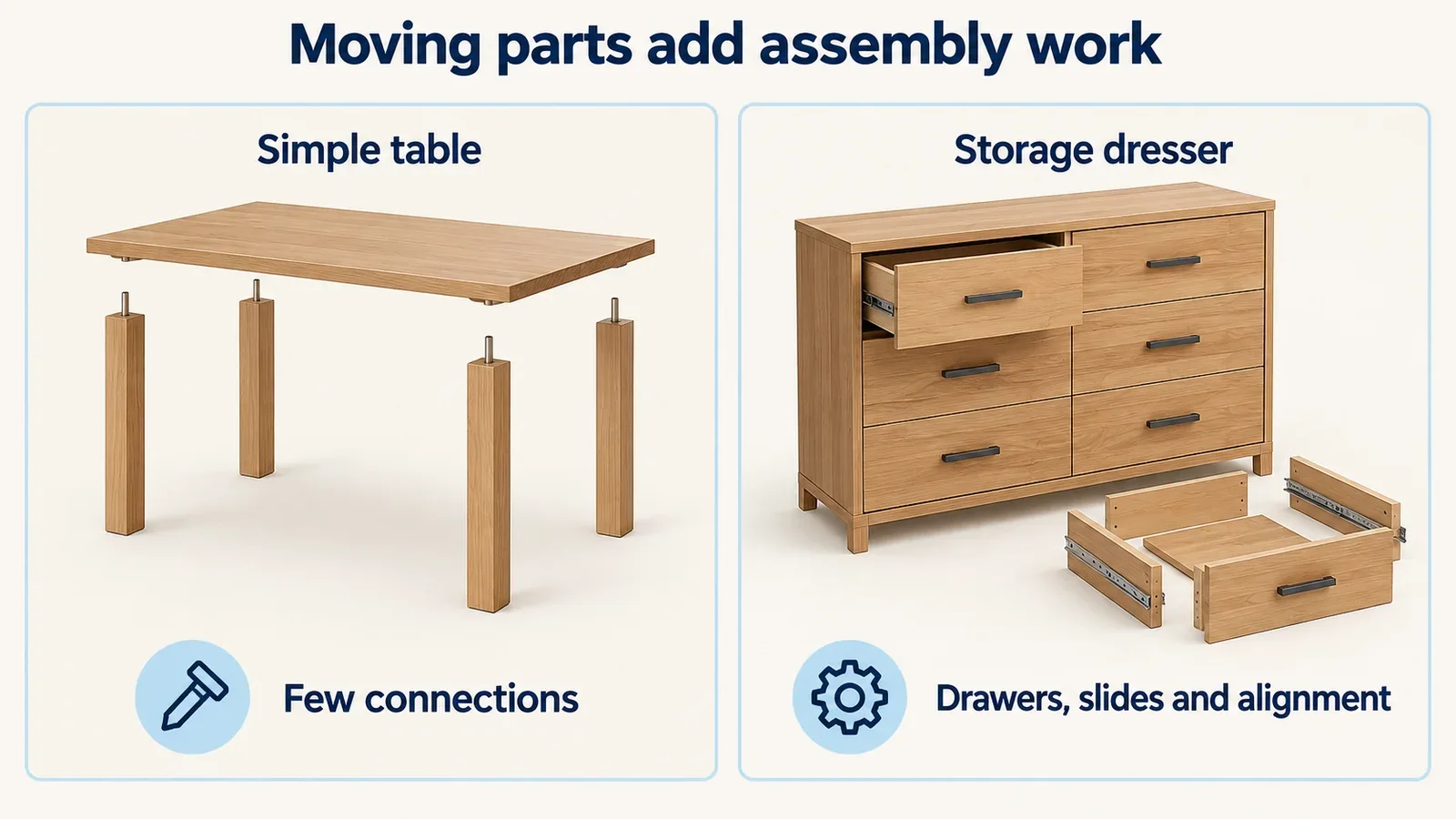
Moving parts are a useful clue to assembly complexity. Each drawer can involve a box, a bottom panel, runners, and a front that needs alignment. Doors bring hinges or tracks into the job. A basic table may occupy more floor space than a dresser while having fewer individual components to fit and adjust.
Taskrabbit’s September 2026 cost guide identifies furniture type, size, complexity, and access as price factors. For your quote, turn those broad categories into observable details: a lift-up bed mechanism, a sliding wardrobe door, an integrated desk, or a narrow assembly area.
Keep freestanding assembly separate from custom installation. Cutting a unit to fit, adding electrical connections, modifying walls, or building trim around a wardrobe changes the scope. If the finished look you want depends on any of those steps, describe it before accepting an assembly-only price. A product photo and its assembly manual help show where the standard kit ends.
Hourly versus fixed pricing: compare the whole bill
An hourly quote needs a rate, an estimated duration, and a billing minimum. Ask whether the rate applies to one person or a team, how partial hours are rounded, and whether carrying boxes is billable time. A fixed quote needs an equally clear list of included items and features, plus the circumstances that would change the price.
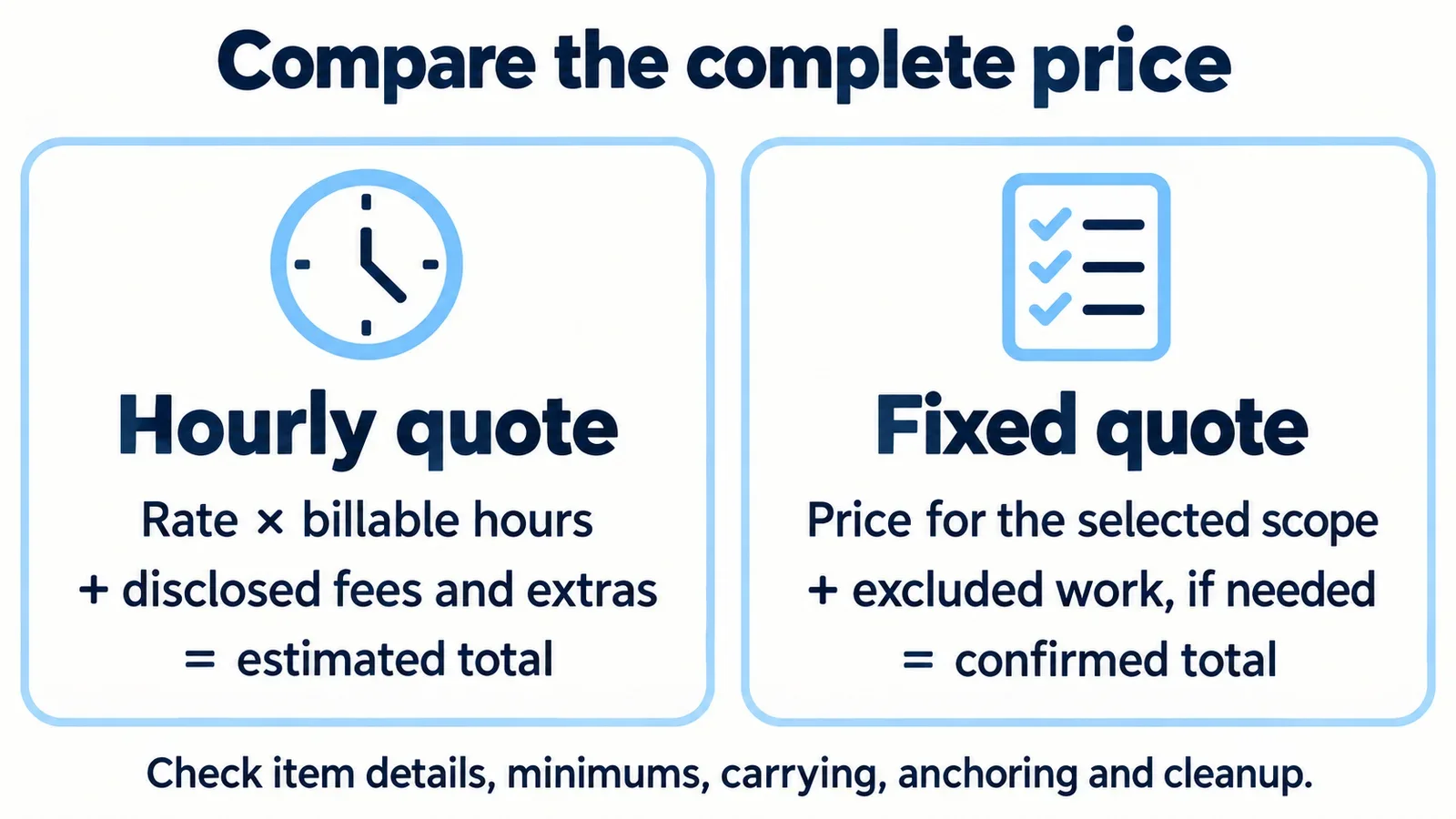
Consider an illustrative quote of $60 per hour with a two-hour minimum. A 75-minute job would still have a $120 labor minimum. If it takes three hours, labor becomes $180. Compare that with a hypothetical $150 fixed quote for the same work. The break-even point is 2.5 billable hours, assuming no additional charges on either quote. These are sample numbers, not UPTask rates.
Platform charges can make a displayed labor rate different from the final bill. Taskrabbit’s fee explanation describes service and support charges and notes that fee presentation differs in California and Massachusetts. Check the actual booking total rather than adding a percentage remembered from another location or an old article.
For several items, ask for a combined quote with each piece identified. One visit may help with a minimum charge, but a bundle does not automatically include a discount. If one item is delayed, confirm whether the remaining appointment and a later return would be priced differently. Compare written totals using the same item list.
Which extra costs should you check?
The word “assembly” does not settle every part of the job. Ask about the tasks around the build as carefully as the furniture itself. A lower quote can be suitable when you have already handled those tasks; it can also become more expensive if the missing work must be added later.
- Carrying and access: Are the cartons already in the final room? Mention stairs, elevators, parking restrictions, and heavy pieces.
- Old furniture: Identify disassembly, moving dismantled parts, and disposal as separate requests.
- Packaging: Clarify whether cleanup means gathering cardboard in the room or removing it from the property.
- Parts and hardware: Ask what happens if a panel is damaged, a fitting is missing, or a replacement visit is needed.
- Anchoring: Confirm the manufacturer’s requirements, the wall type, suitable hardware, and what installation is included.
- Final charges: Check any applicable taxes, platform fees, travel charges, minimums, and requested extras before confirming.
For example, IKEA states that its Taskrabbit assembly service includes installing tip-over restraints but excludes packaging disposal, electrical work, plumbing, and kitchen and bath installation. It also asks customers to put packages in the room where the finished item will stay. Those are that service’s terms; compare other providers’ own descriptions rather than assuming the same inclusions.
Required safety steps belong in the scope from the beginning. The U.S. Consumer Product Safety Commission advises securing top-heavy furniture and following the manufacturer’s anchoring instructions. Resolve wall and hardware questions before treating the assembly as complete. Skipping a required restraint is not an appropriate way to reduce the quote.
When does DIY assembly make financial sense?
Start by reading the actual instructions, including the tools and number of people required. Then compare the paid quote with your available time, equipment, workspace, and ability to handle the components safely. For a straightforward item, doing it yourself may be an easy saving. For a complicated system, paying for assembly may solve a practical limitation.
A simple personal calculation can help: divide the complete quote by the hours you realistically expect to spend. If a $150 service would save you five hours, you are paying $30 for each hour saved. That is an illustrative decision aid, not a claim about professional build times or the value of your time. Include any tools you would otherwise need to buy.
You can also split the work deliberately. Assemble the pieces you are comfortable handling and request help with the difficult ones. Before starting an item you may hand over, ask how partially assembled furniture is quoted. The assembler may need to inspect or undo earlier steps, so a half-finished build does not necessarily mean half the price.
Get an accurate quote before assembly day
Send one complete description to each provider. Include the product link or model number, quantity, assembled dimensions, moving parts, and the work you expect beyond the basic build. A photograph of the delivery labels can help distinguish several boxes belonging to one item from several separate pieces.
- Confirm that every carton has arrived and identify any visible delivery damage.
- Choose the final furniture location and check the manufacturer’s assembly-space requirements.
- Keep the instructions and hardware together, following the provider’s preparation directions.
- Describe carrying, removal, anchoring, or other extra work before the visit.
- Save the itemized quote and confirm how changes or incomplete deliveries will be handled.
For a Bay Area project, review UPTask’s furniture assembly options and configure the pieces you actually need built. Use the current service description and booking total to make the decision. The best price comparison is a complete, matching scope that leaves you with the furniture assembled where you need it.