How Long Does Furniture Assembly Take? Times by Furniture Type
See how furniture type and configuration affect assembly time, then build a realistic schedule for the complete job.
Table of contents
Start with the item, then define what “finished” meansPublished assembly times by furniture typeWhy drawers, doors, and mechanisms change the schedulePlan a complete appointment with a simple time budgetDecide whether DIY or professional help fits your dayPrepare the room without creating extra workGet an estimate you can actually schedule around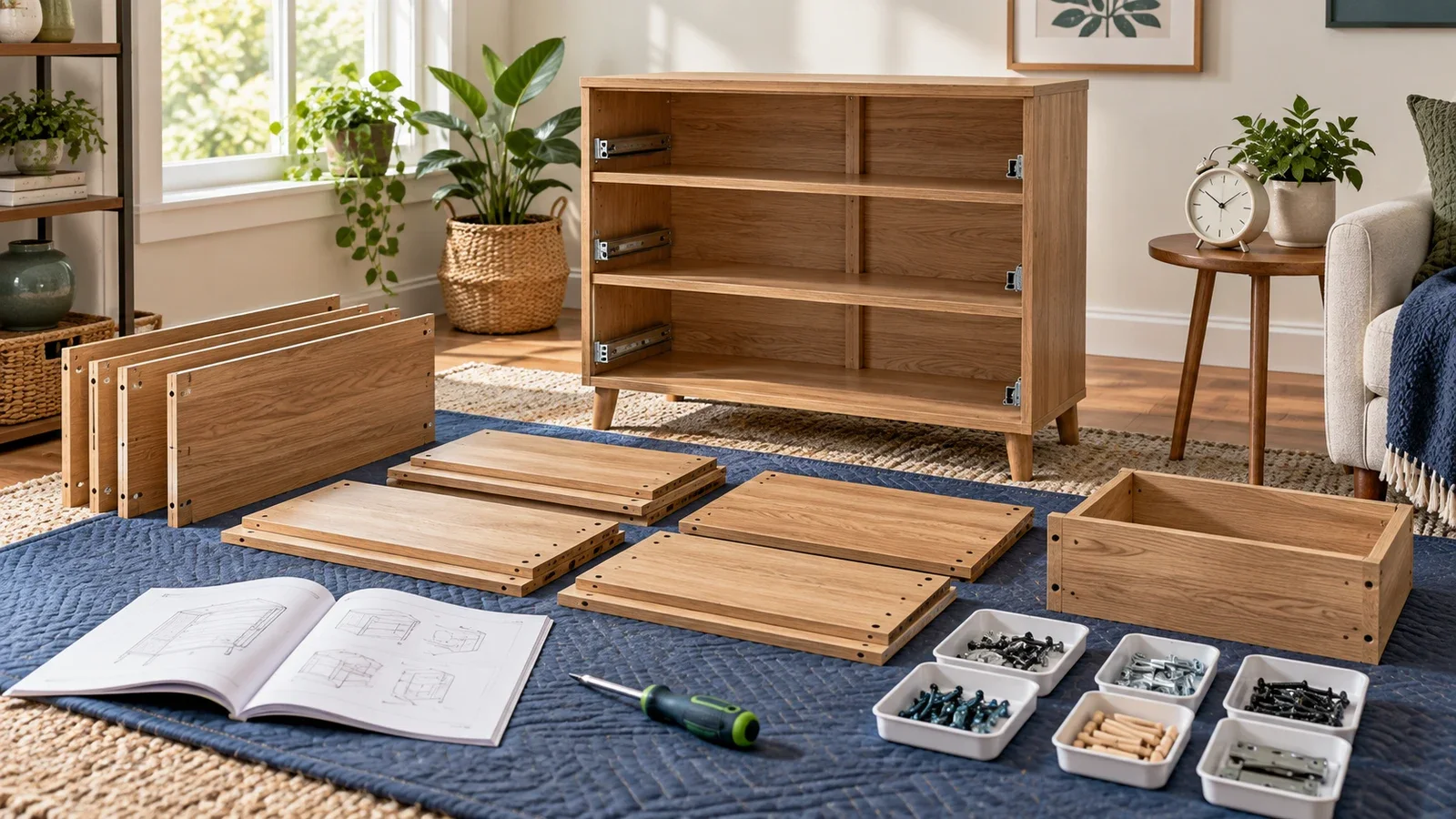
Furniture assembly often needs one to four hours, according to Taskrabbit’s general service guidance, but that broad range cannot predict every item. A simple chair can be much quicker than a dresser with several drawers, while a fitted wardrobe configuration can require a longer appointment. The best estimate starts with the exact model and includes preparation, assembly, adjustment, and any required anchoring. Use the benchmarks below to plan the day, then confirm your own scope.
Start with the item, then define what “finished” means
A time estimate is useful only when you know where the clock starts and stops. One person may count the minutes spent joining panels. Another may include opening cartons, carrying parts upstairs, finding suitable wall fixings, and gathering the packaging. Those are different jobs even when the furniture model is identical. Ask for an estimate for the whole service you need.
For your own schedule, separate hands-on assembly time from the full appointment window. A booking arrival window is different again: it describes when someone is expected to arrive, not when the furniture will be ready. Avoid scheduling a delivery, important call, or departure at the earliest possible completion time unless you have confirmed that timing with the provider.
Think of completion as a short acceptance check. The item is in its agreed location, doors and drawers work correctly, supplied components are installed, and required safety steps are complete. Any excluded work should already be clear. A dresser that looks finished but still needs its specified restraint has not reached the same endpoint as a fully completed installation.
Published assembly times by furniture type
Providers publish noticeably different estimates. The following examples come from Duurs’ September 2026 guide and describe professional assembly, not a measured UPTask average or a guaranteed appointment length. Treat them as a starting point for questions. The exact product, team size, included tasks, and work area can move your job outside the stated range.
| Furniture | Published estimate | Detail to confirm |
|---|---|---|
| Office chair | 15–30 minutes | Arms, base, back and adjustments |
| Bookshelf | 30–45 minutes | Size, backing and required anchoring |
| Desk | 45–75 minutes | Drawers, storage and moving mechanisms |
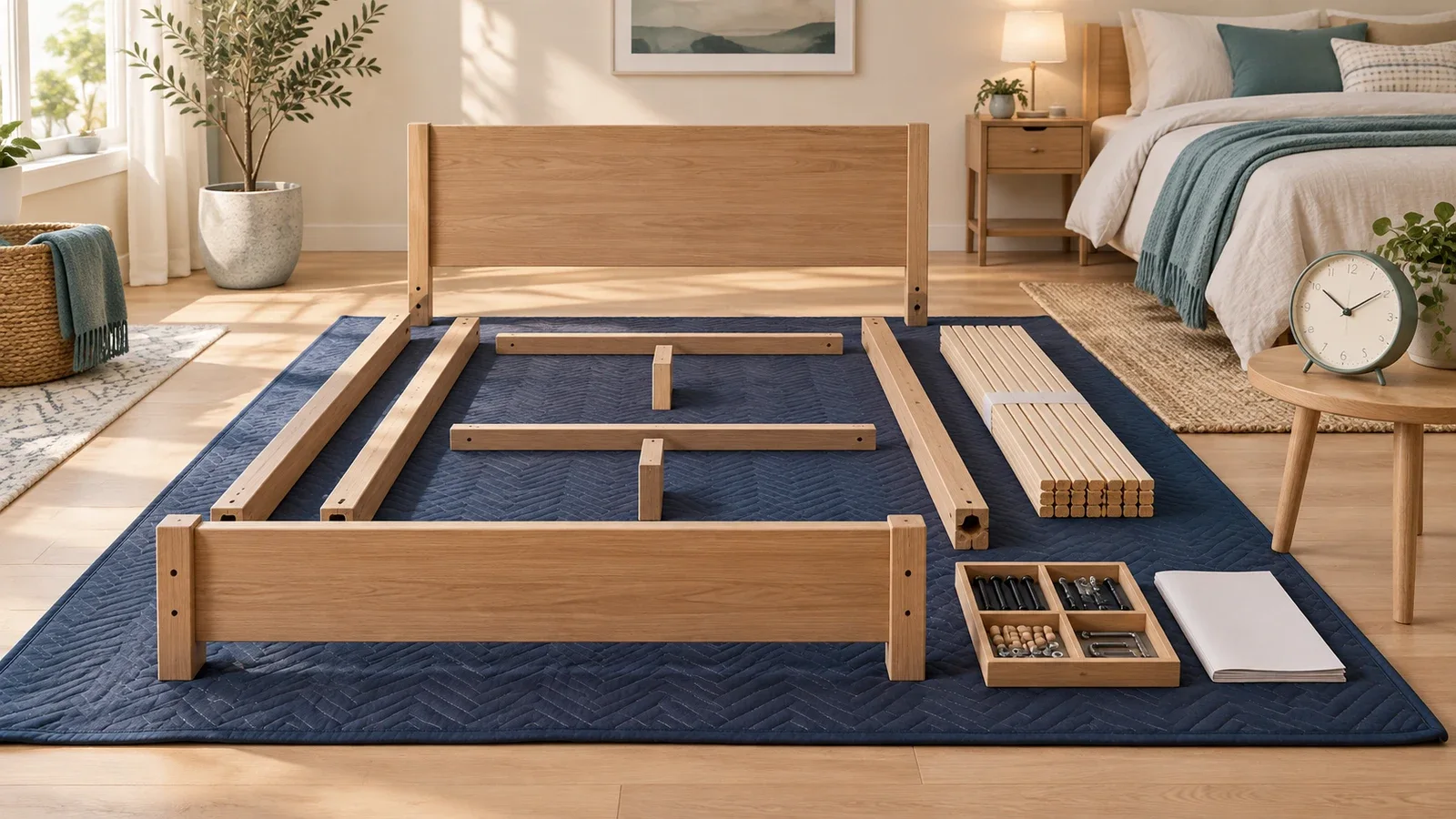
| Bed frame | 45–90 minutes | Storage, headboard and supplied supports |
| Six- to eight-drawer dresser | 1–2 hours | Drawer construction and runner alignment |
| Wardrobe system, per section | 2–4 hours | Frame, doors, interior fittings and wall work |
The differences between providers are a reason to avoid treating a search result as a deadline. Flat Rate Assembly’s April 2026 NYC guide, for example, lists 30–45 minutes for a professional to build a six-drawer dresser, while Duurs gives one to two hours for a six- to eight-drawer dresser. The categories and operating assumptions are not identical. Neither figure establishes a universal time for your model.
When a range seems surprisingly short, ask what it covers. A preassembled drawer unit with legs to attach is different from a flat-pack dresser whose drawers each need to be built. A bed with a basic frame is different from one with storage drawers or a lifting mechanism. Send the product information rather than relying on “a desk” or “a queen bed.”
Why drawers, doors, and mechanisms change the schedule
The outside dimensions tell only part of the story. Drawers add separate boxes, runners, fronts, and adjustments. Doors add hinges or tracks and gaps that need checking. A wide table can have relatively few connections, while a smaller storage unit can require many repeated steps. Count moving components before comparing two pieces of similar size.
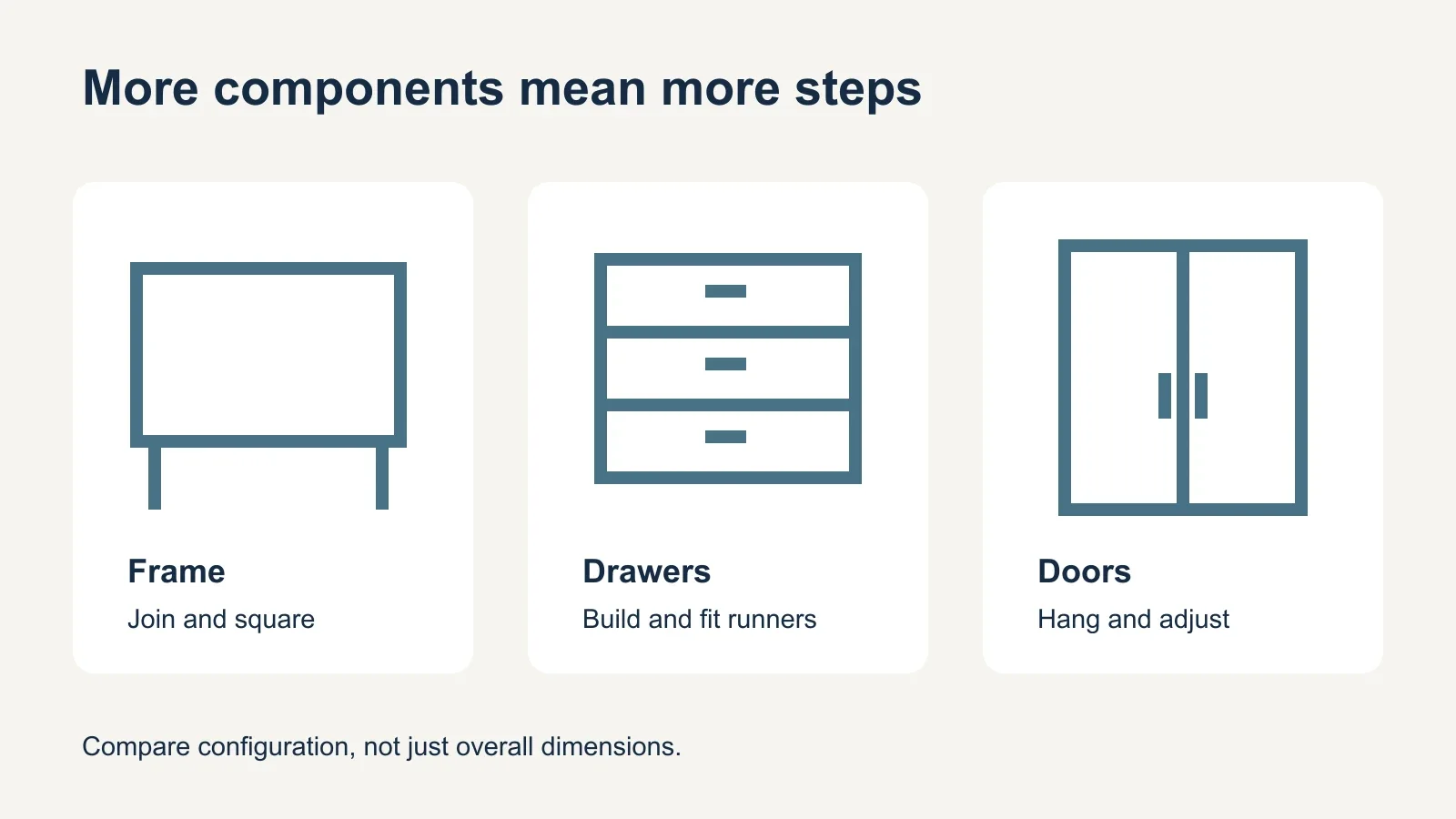
Describe special features explicitly. Examples include a lift-up bed base, integrated shelving, a corner desk, or a sliding-door wardrobe. Electrical connections and custom carpentry should be discussed separately from ordinary furniture assembly. A photograph can help, but the model number and current instructions explain details that a finished-product photograph may hide.
For a dresser, note the drawer count and whether the hardware arrives attached or separate. For a bed, identify storage and the supplied support system. For a wardrobe, list frames, doors, shelves, drawers, and other inserts. UPTask’s dresser assembly and wardrobe assembly pages help you describe those configurations before requesting a complete estimate.
Plan a complete appointment with a simple time budget
Use a worksheet with four parts: preparation, the builds themselves, installation or adjustment, and the agreed cleanup. Assign estimates only after reviewing the actual item list. This makes hidden tasks visible and gives the provider a useful starting point. It also prevents a multi-item order from being reduced to one misleading average per piece.
Here is a hypothetical planning example, not a provider promise. Allow 20 minutes to organize the work area, 45 minutes for a simple desk, 90 minutes for a dresser, and 25 minutes for final adjustment and agreed cleanup. The total is 180 minutes, or three hours. If the provider expects another 30 minutes for carrying, your personal appointment budget becomes three and a half hours.
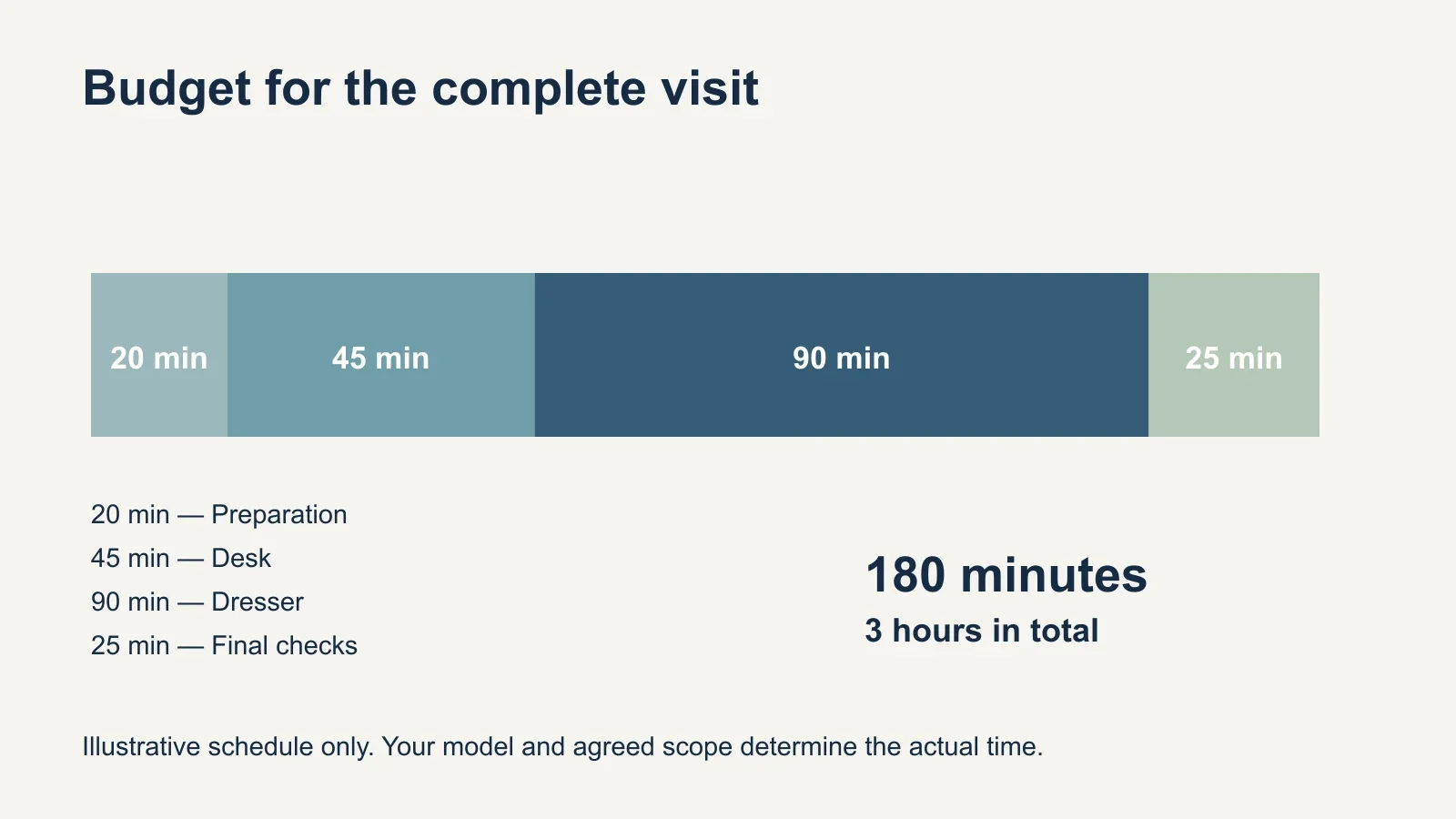
Do not treat this arithmetic as proof that the visit will finish at an exact time. A missing panel or unsuitable wall attachment can stop work rather than merely add a predictable number of minutes. Decide which item matters most if everything cannot be completed together, and agree what happens when a delivery is incomplete. That decision is particularly useful during a move.
Decide whether DIY or professional help fits your day
DIY time depends on your familiarity with the instructions, available tools, ability to handle the parts, and room to work. Published comparisons commonly allow more time for a first build, but “twice as long” is not a reliable rule for every product. Review the instructions before committing your evening, especially when the furniture has many repeated drawer or hinge steps.
A second person can help with handling and positioning, but two people do not automatically cut the duration in half. Some tasks must happen in sequence, and some need coordinated lifting. Follow the product’s staffing requirements. IKEA recommends at least two people for PAX assembly for safety and to avoid damage; that guidance should not be replaced by a faster solo schedule.
Keep elapsed time separate from labor-hours when comparing quotes. Two people working for two hours represent four labor-hours, even though only two hours pass on the clock. Ask whether a quoted rate covers one person or a team. For the related pricing decision, read the furniture assembly cost guide, which explains scope, minimums, and configuration-based charges.
Prepare the room without creating extra work
Good preparation means removing uncertainty, not starting steps the assembler may need to reverse. Confirm delivery completeness, identify the final location, and keep the instructions with the correct cartons. Before unpacking everything, ask how the provider wants parts staged. Similar-looking hardware from several products is easier to confuse when all the bags have been emptied together.
- Confirm the exact model and check that every carton has arrived.
- Choose the final location and provide the assembly space required by the instructions.
- Explain stairs, elevators, parking restrictions, and any carrying request.
- Keep hardware and instructions grouped by item.
- Agree who handles required wall attachment and suitable fixings.
- Clarify whether cleanup includes gathering packaging or taking it away.
Service descriptions vary. IKEA’s U.S. assembly guidance asks for packages to be in the room where the finished item will stay, includes specified tip-over restraints, and excludes packaging disposal. Those are IKEA’s service terms, not universal rules for every booking. Check your own provider’s inclusions instead of assuming that clearing cartons or moving old furniture is part of assembly.
Protect the work area according to the manufacturer’s directions and keep children and pets away from loose hardware and unfinished furniture. Do not rush a required safety step to recover lost time. The CPSC advises following manufacturers’ instructions for securing furniture and anchoring top-heavy pieces. If an anchoring requirement cannot be completed, resolve that issue before treating the item as ready for use.
Get an estimate you can actually schedule around
Send the complete product list in one message and describe the work beyond the build. Ask for a likely duration, the assumptions behind it, the number of assemblers, and the circumstances that could extend the visit. A useful response connects the estimate to your actual configuration instead of giving a single time for every item in a broad furniture category.
- Which items and fittings are included in this estimate?
- Does it include carrying, adjustment, required anchoring, and cleanup?
- How many people will attend, and does the quote cover the team?
- What should be prepared before arrival?
- What happens if a part is missing or the job runs longer?
For a Bay Area project, start with UPTask’s furniture assembly options and identify the exact pieces you need built. Keep the product details, delivery status, and room information together. A realistic assembly day starts with a complete scope and enough flexibility to finish the checks that make the furniture usable, rather than a race to match the shortest published time.