IKEA BESTÅ Wall Mounting: A Guide for Cabinets and TV Units
BESTÅ cabinets and TV benches use different wall-mounting arrangements. Identify your frame, check the wall and plan the finished layout before choosing hardware.
Table of contents
Identify the cabinet before buying mounting hardwareConfirm the wall and attachment planPlan height, lifting clearance and everyday accessKeep furniture limits separate from wall capacityAllow for cables, ventilation and final adjustmentsPrepare a clear brief for the assembly appointment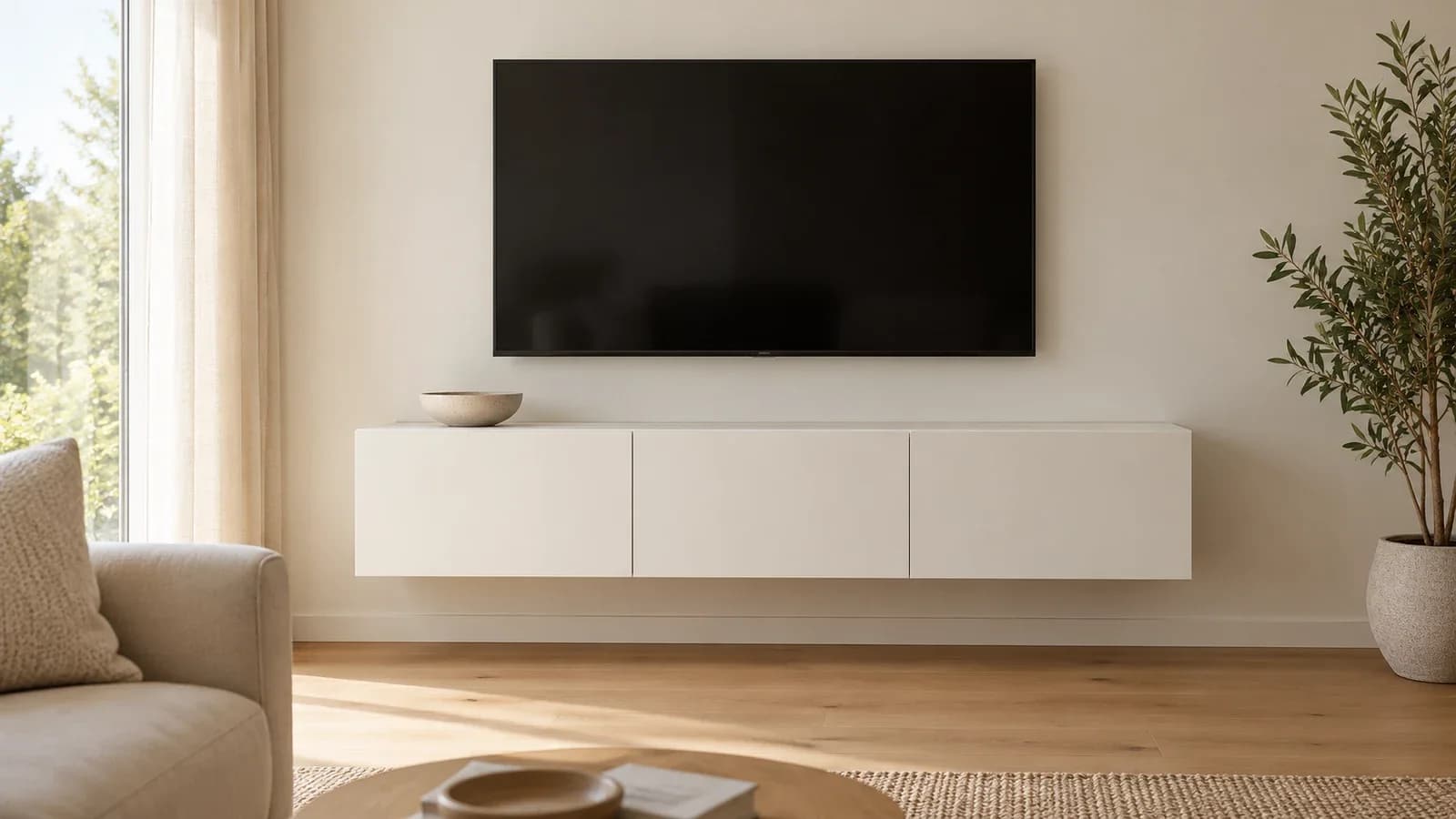
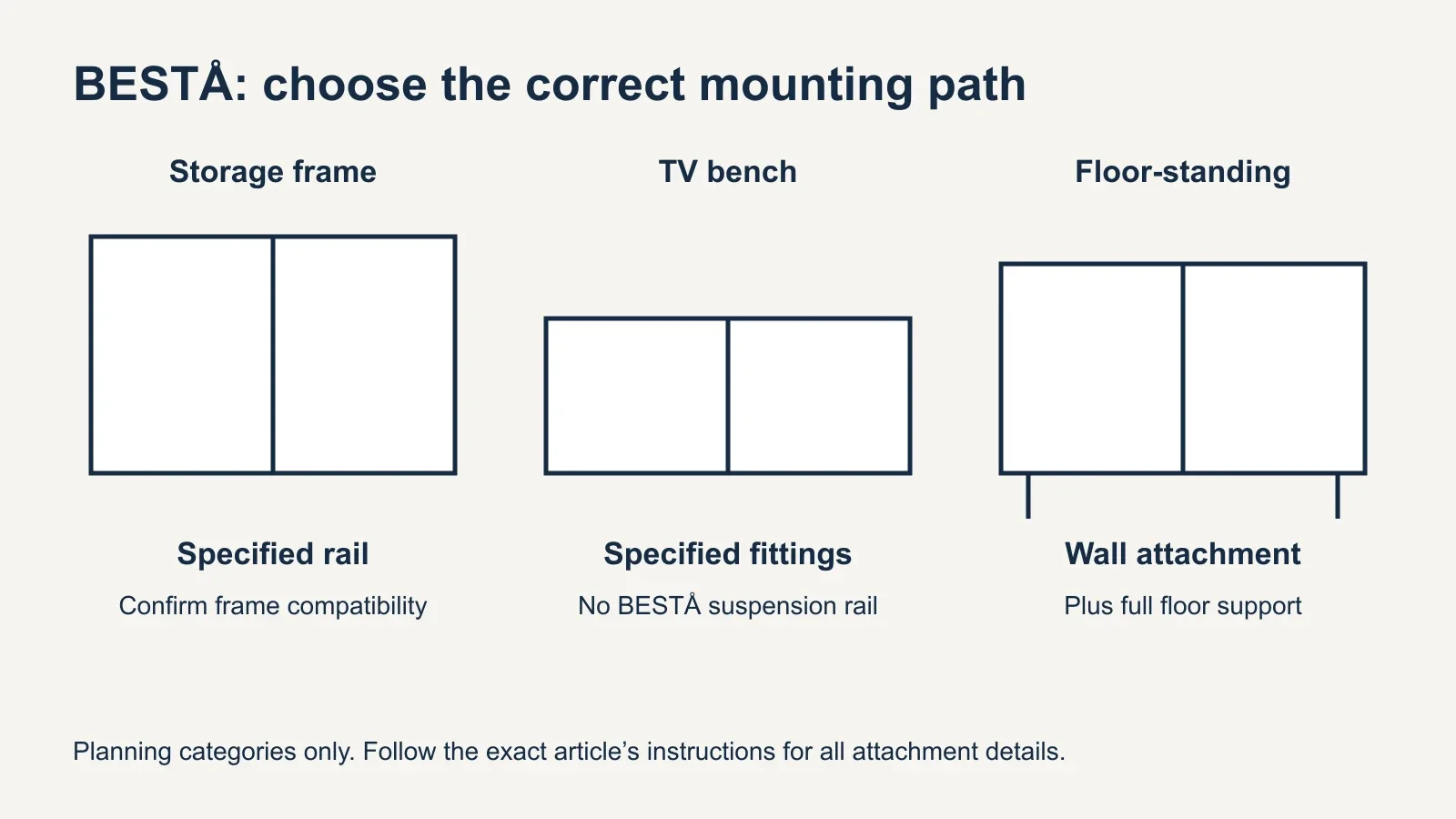
Many IKEA BESTÅ storage frames and TV benches can be wall-mounted, but they do not all use the same hardware. Compatible storage frames use the BESTÅ suspension rail; BESTÅ TV benches must not use that rail. Start with the exact article number and its instructions, then confirm the wall can support the complete installation. A floor-standing BESTÅ also needs its specified wall attachment, even though the floor carries its weight.
Identify the cabinet before buying mounting hardware
BESTÅ is a family of products, not one universal cabinet. A low storage frame can look similar to a TV bench once doors are installed. Check the label, order details or component list rather than deciding from the finished appearance. Record the article numbers for each frame and the supplied mounting fittings, especially if you are combining new and older units.
| Your configuration | Mounting approach | Key check |
|---|---|---|
| Compatible wall-hung storage frame | BESTÅ suspension rail specified for that frame | Exact frame instructions and required rail quantity |
| Wall-hung BESTÅ TV bench | Its specified wall fittings; no BESTÅ rail | TV bench article number and mounting instructions |
| Floor-standing frame or TV bench | Specified wall attachment for tip-over prevention | Complete floor support plus secure wall attachment |
For example, IKEA’s US listing for the white 23 5/8-by-15 3/4-by-25 1/4-inch frame, article 302.458.50, requires one suspension rail when wall-mounted. The current 47 1/4-inch TV unit, article 905.660.32, instead uses its specified wall fittings. Similar width or matching doors do not establish that two products share an installation method.
If a secondhand unit has no identifiable article number or missing fittings, resolve that first. Ask IKEA to identify the product and correct parts. Do not recreate a suspension system with spare brackets, drill extra mounting points through a panel or assume an older manual applies to a newer frame.
Confirm the wall and attachment plan
The wall finish is only part of the assessment. The installer needs to identify the supporting construction, its condition and the required attachment positions. Painted drywall, plaster and masonry can call for different arrangements. IKEA’s US suspension-rail guidance calls for attachment to a wall stud; the rail is not permission to hang a loaded cabinet from arbitrary drywall anchors.
The rail instructions also require assessing the wall and selecting wall screws and plugs for the intended load. Those wall fasteners are not included. A packet marked “heavy duty” does not establish suitability for your wall, the cabinet or its mounting geometry. If the required attachment points cannot be supported, have the layout or supporting construction assessed before installation.
Tell the installer about known plumbing, wiring, previous repairs and anything unusual behind the proposed cabinet. Outlets and switches should be included on the layout before drilling positions are chosen. Do not assume a stud finder alone rules out every concealed service, or that a hole left by previous furniture is suitable for the new installation.
For the separate question of which floor-standing pieces need restraint, see the furniture wall-anchoring guide. A tip-over restraint and a suspension system have different jobs. Keeping a cabinet on legs does not remove its attachment requirements, and removing its legs does not convert an ordinary restraint into an approved hanging system.
Plan height, lifting clearance and everyday access
Choose the cabinet’s finished position before marking rail or bracket holes. Measure the floor-to-bottom height, total width and distance from adjacent walls. Check the doors’ swing, nearby trim and access to outlets. For a run of several units, use one layout for the whole arrangement so an individual cabinet does not end up centered while the full run looks misplaced.
For compatible frames on the current BESTÅ suspension rail, IKEA specifies at least 2 inches between the frame top and ceiling so the frame can be mounted onto the rail. This is mounting clearance, not a universal gap for every BESTÅ product. Use the TV bench’s own instructions for its mounting arrangement and leave working access for the installer.
Plan the television separately. A wall-mounted TV needs its own compatible mount and wall assessment; a cabinet underneath it is not the TV’s support. Check viewing position, soundbar placement and access to connections together. Before finalizing the cabinet height, mark its outline temporarily on the wall and view the arrangement from the normal seating position.
Think through future access as well as installation day. Can you remove a cable without taking down the furniture? Will a cabinet door strike the sofa, an adjacent wall or a device? A neat-looking layout that hides every connection may create avoidable work when you replace a router or streaming box.
Keep furniture limits separate from wall capacity
There is no reliable universal answer to “How much weight can wall-mounted BESTÅ hold?” IKEA states that the maximum load of a wall-hung frame or TV bench depends on the wall material. Furniture limits still apply too. The intended installation needs to satisfy the product requirements and the wall-and-fastener requirements together.
The current US 47 1/4-inch TV unit lists a maximum TV weight of 35 pounds on its top; the 70 7/8-inch version lists 66 pounds. These are model-specific top-panel limits, not certified capacities for every wall installation. Do not transfer either figure to another cabinet or add multiple listed limits together to invent a wall rating.
Describe what you plan to store: electronics, books, records, glassware or other contents. Include doors, drawers, shelves and added tops in the configuration shared with the installer. Dense contents can change the loading substantially. If the intended contents or configuration change later, reassess them before adding weight to a wall-hung unit.
Allow for cables, ventilation and final adjustments
Use the product’s designed cable openings where provided, and check the equipment manufacturers’ ventilation requirements. Leave outlets and required controls accessible. Avoid trapping cords behind brackets or between moving parts. A closed cabinet may look clean while leaving an amplifier or other heat-producing device without its required clearance.
If you want a cleaner cable route, compare the options in hiding TV wires without cutting the wall. Cabinet assembly, TV mounting, cable concealment and electrical alterations are separate parts of the project. Confirm which are included rather than assuming an assembly appointment covers all four.
Once the cabinet is installed as instructed, check alignment and door operation before loading it. A door adjustment should not be used to disguise a twisted frame or an insecure mounting point. If the cabinet moves unexpectedly, sags or pulls away from the wall, keep people clear and arrange an assessment; do not try to fix a loaded suspended unit by tightening random screws.
Prepare a clear brief for the assembly appointment
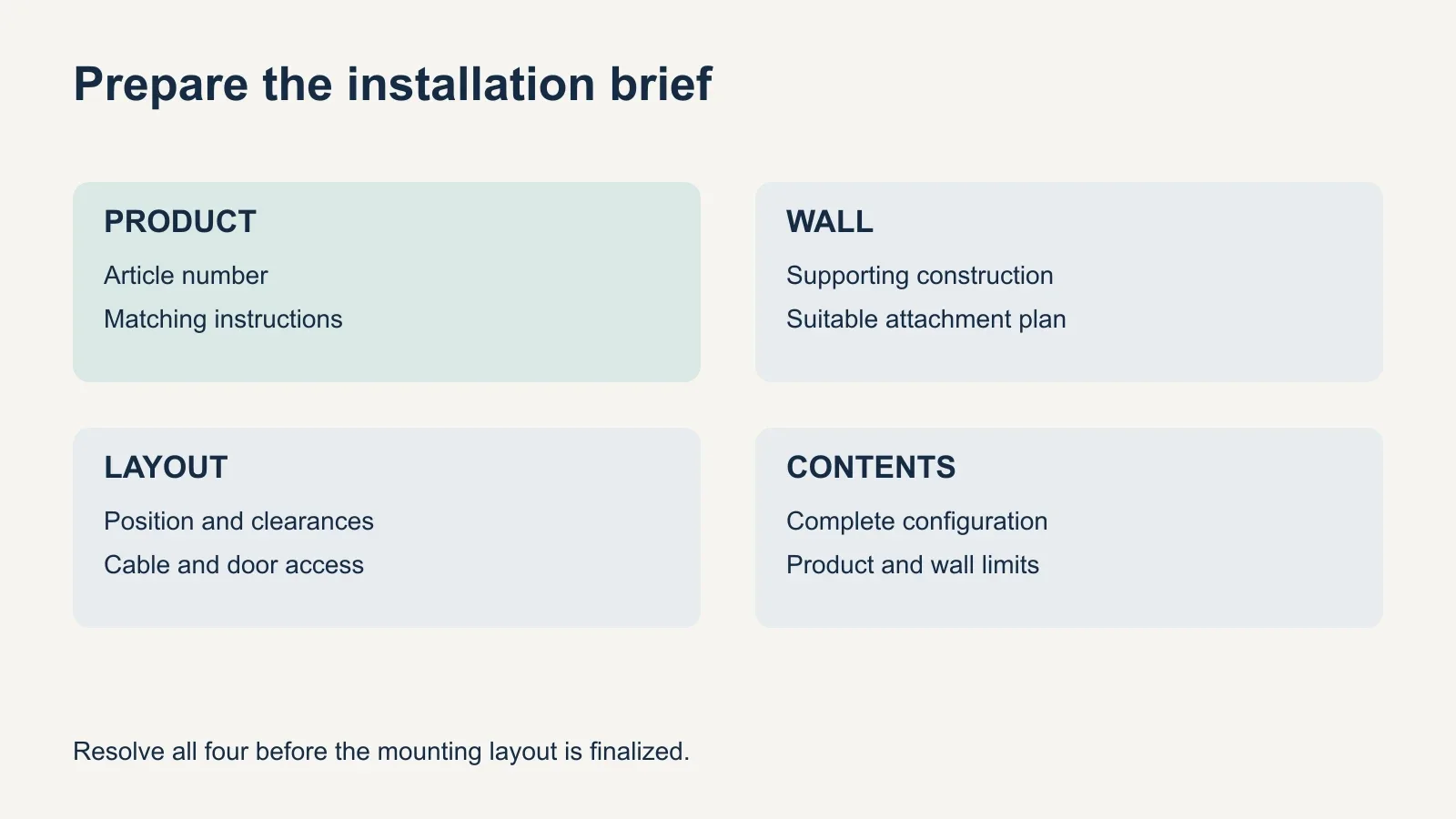
- List every frame or TV bench article number and collect its current instructions.
- Specify wall-hung or floor-standing installation and identify the required mounting components.
- Share wall photographs, known construction and any access restrictions.
- Record the desired finished position, ceiling clearance and door clearance.
- Describe the intended contents, television arrangement and cable route.
- Confirm responsibility for mounting, any wall preparation and related electrical work.
Keep the correct fittings together and clear the working area before the appointment. After installation, retain the instructions and follow IKEA’s guidance to check assembly fastenings regularly and retighten when necessary. Access for inspection should remain possible; decorative additions should not conceal a problem or obstruct required maintenance.
For help with the furniture portion, share the model list and wall-mounting plan when arranging furniture assembly with UPTask. Confirm the mounting scope and any wall work in advance. The useful starting point is a known product, a suitable wall and a layout that can be installed and maintained as specified.