IKEA BILLY vs KALLAX: Which Is Better for Books and Storage?
BILLY’s adjustable shelves suit a book collection; KALLAX’s deeper cubes suit grouped storage. Compare dimensions, loading, accessories, and the items you actually own.
Table of contents
Start with what you want to storeBILLY gives a book collection adjustable shelf heightsKALLAX organizes storage into fixed compartmentsCompare weight limits for the exact sizeInclude accessories, assembly, and anchoring in the planUse a five-point check to make the choice
Choose BILLY when your main task is organizing books on adjustable shelves; choose KALLAX when you want separate, deeper compartments for boxes and mixed storage. Both can hold books, and neither is automatically the better choice for every collection. Check your tallest items, the depth of your containers, and the load limit of the exact size. Also plan the wall attachment before deciding where either unit will stand.
Start with what you want to store
A row of paperbacks and a collection of craft supplies need different layouts. Books are easiest to browse when their spines remain visible and each shelf has enough height without wasting large gaps above them. Small loose items usually benefit from containers that can be pulled out together. Decide which of those tasks makes up most of your storage before choosing a silhouette.
Sort the intended contents into three groups: things you reach for often, things you want to display, and things you prefer to conceal. Then choose a few awkward examples rather than measuring only the average item. A tall art book, a board-game box, or a bulky fabric bin can determine whether a shelf is useful even when most of your collection fits easily.
| Decision | BILLY | KALLAX |
|---|---|---|
| Mostly books of different heights | Adjustable shelves help group books by height | Fixed cube openings divide the collection into smaller groups |
| Loose supplies and toys | Choose containers that fit the shelf depth | Boxes and compatible inserts organize separate cubes |
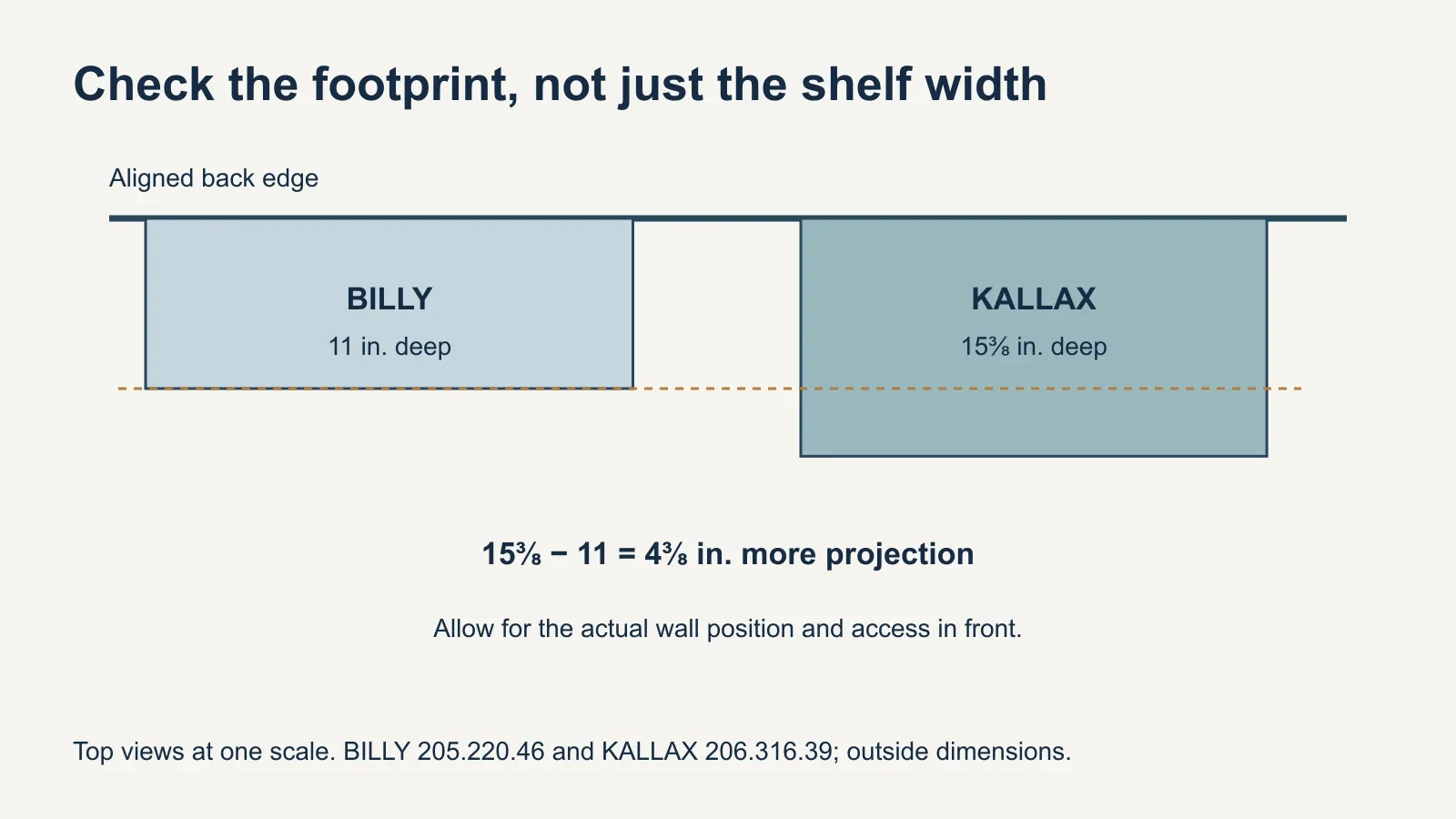
| Limited floor depth | The referenced standard model is 11 in. deep | The referenced cube unit is 15⅜ in. deep |
| Display style | Longer rows with a back panel | A grid with open backs unless inserts close them |
| Changes later | Compatible extra shelves, doors, or height extensions | Compatible boxes, doors, drawers, and other inserts |
| Installation | Plan assembly space and wall attachment | Plan the orientation, accessories, and wall attachment |
BILLY gives a book collection adjustable shelf heights
The white 31½ × 11 × 79½-inch BILLY, article 205.220.46, includes four adjustable shelves and one fixed shelf. The adjustable shelves let you group shorter books together and leave a taller opening where needed. The fixed shelf remains part of the structure; do not treat every horizontal panel as something you can remove to fit a large object.
For a mostly book-based layout, measure the books upright as you intend to store them. Leave enough room above the tallest spine to remove it comfortably. If you place small books in front of another row, decide whether hiding the back row defeats the purpose of having an accessible library. More depth is not always more useful storage.
A tall bookcase can use wall height while occupying a relatively shallow footprint. It also requires access for assembly and anchoring. If you eventually want a continuous library wall, plan the full arrangement, clearances, and trim separately; our BILLY built-in planning guide covers that larger project.
KALLAX organizes storage into fixed compartments
KALLAX works well when you prefer one category per compartment: paperwork in one, games in another, and a removable box of supplies below. Its grid creates natural boundaries. That can make a shared room easier to organize, but an object that is just too tall for a cube cannot be accommodated by moving the divider up one position.
The current white four-cube unit, article 206.316.39, is listed at 30⅛ inches wide, 15⅜ inches deep, and 30⅛ inches high. Those are outside dimensions. They do not tell you the clear opening inside a cube or the usable capacity of an added drawer. Check the chosen insert’s dimensions and compatibility, especially when buying accessories for an older unit.
A box may fit the opening yet still be awkward to use if its handle catches, its rim sticks out, or there is not enough space to pull it forward. Test one representative container before buying a full set. For records, binders, or large books, check their sleeves and covers too; the bare object’s dimensions may understate the room it needs.
Compare weight limits for the exact size
The wide BILLY example lists a maximum of 66 pounds per shelf. The narrower 15¾ × 11 × 79½-inch BILLY, article 505.220.40, lists 31 pounds per shelf. The four-cube KALLAX example lists 29 pounds per shelf. These figures show why a family name alone is not enough to decide whether a particular collection is suitable.
Do not convert those ratings into a whole-unit allowance by multiplying them, or transfer a rating from one width or installation orientation to another. Follow the exact product’s loading conditions. A wall-hung configuration has additional requirements, and its capacity cannot be inferred from a floor-standing shelf rating. This guide is comparing storage choices, not designing a wall-hung installation.
Books, records, and binders can become heavy before a compartment looks full. Weigh a representative group and estimate the intended load for each shelf rather than relying on appearance. Include the container or insert where relevant to the stated limit. Keep heavy items low and distribute the contents according to the instructions; a visually balanced display is not a load calculation.
Include accessories, assembly, and anchoring in the plan
Compare the finished setup rather than only the empty frame. Doors, extra shelves, boxes, drawers, underframes, and delivery can change the total purchase. Make two complete component lists with the same storage goal. For example, comparing an open bookcase with a cube unit filled with concealed-storage inserts is a comparison of different finished functions, even when their frame prices look similar.
Do not mix accessories across systems because their nominal widths seem close. Confirm the product family, article number, and supported combination. Doors also need opening room, and an underframe changes the overall height and attachment arrangement. If you plan to turn a rectangular KALLAX unit horizontally, verify that the particular size and accessories permit that orientation.
Both example units require secure wall attachment under their instructions. A low unit is not exempt simply because it feels stable when empty. Choose wall fasteners appropriate for the actual wall and follow the included restraint method. For a broader room check, read which furniture needs wall anchoring. Do not interpret an attractive room-divider photograph as permission to omit a required restraint.
Clear enough floor space to handle the panels without forcing them against other furniture. Follow the manual’s order, including structural dividers and the back panel where supplied. Arrange help for lifting when the instructions call for it. Damage at an attachment point, a bowed panel, or a missing structural piece should be resolved before loading the unit.
Use a five-point check to make the choice
- Pick the main storage task: visible rows of books or separately grouped compartments.
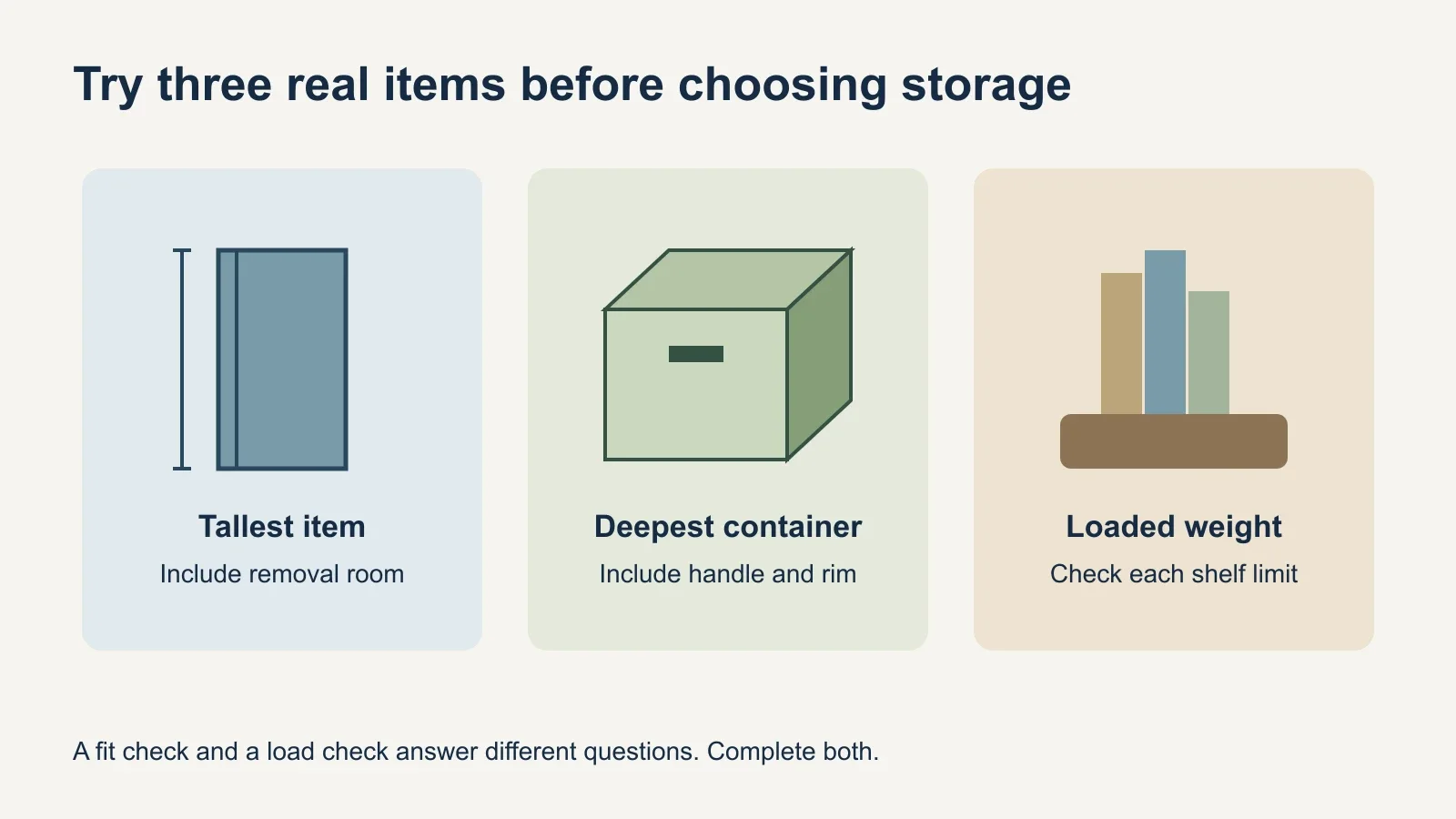
- Measure the tallest and deepest intended items, including their containers.
- Check each planned shelf load against the exact product’s stated limit.
- Mark the outside footprint and test door, drawer, and walking clearances.
- Confirm the complete accessory list, assembly space, and wall-attachment plan.
If most of your contents are books with different heights, start by testing a BILLY layout. If the room needs bins for several categories of everyday items, start with KALLAX. A mixed room can use both, provided each piece earns its footprint. When requesting furniture assembly help, share the sizes, accessory list, and wall location so the scope includes the whole storage arrangement.