How Much Does It Cost to Assemble Furniture for an Entire Apartment?
Estimate a whole-apartment assembly job from the actual furniture list, with an eight-piece budget example and a practical way to compare complete quotes.
Table of contents
Start with an inventory, not an apartment labelUse an itemized example to understand the arithmeticCompare fixed quotes with hourly estimates fairlyCheck which services sit outside assemblyUse verified local prices for the pieces you knowReduce avoidable visits without assuming a discountSend one complete brief to each provider
The cost to assemble an entire apartment is the sum of its specific furniture builds and any separately agreed services. An illustrative eight-piece budget below totals $500 for assembly, or $600 with two hypothetical extras. These are calculation examples, not a national average or UPTask package. The number of drawers, storage features, separate units and required installation steps matters more than the number of bedrooms.
Start with an inventory, not an apartment label
A studio can contain a storage bed, a large wardrobe and a complicated workstation. A larger apartment might need only a straightforward bed and dining set because the other furniture arrives assembled. Square footage and room count therefore cannot tell an assembler what is inside the cartons. Make the furniture list first, then request the price for that list.
Count completed pieces rather than delivery boxes or shopping-cart lines. A dining set with one table and two chairs contains three pieces even if it was sold as a single product. A wardrobe may arrive in several cartons that together make one specified configuration. Follow the provider’s counting method, and include every frame, door and interior fitting that belongs to that configuration.
- Bedroom: bed type and size, storage drawers, headboard features, dressers and nightstands.
- Living area: TV stand, bookcases, cabinets, sofa sections and any supplied connectors.
- Dining area: table, extensions and the number of individual seats.
- Work area: desk, return section, drawer unit, hutch and separate chair.
- Storage: wardrobe frames, doors, shelves and pull-out fittings.
For each entry, keep the product name, model number, quantity and final room together. Include a product reference or the actual instructions when asking for a quote. Note whether it is new in its packaging, already started, or being reassembled after a move. Those descriptions identify different work, even when the finished furniture looks identical.
Use an itemized example to understand the arithmetic
The following is an invented quote for eight pieces in an apartment with an existing sofa and built-in closet. Its purpose is to show how to calculate a total and notice omissions. Replace every amount with a quote for your own model and location. The furniture purchase price, delivery and other services are outside the assembly subtotal.
| Furniture to assemble | Quantity × example price | Line total |
|---|---|---|
| Standard bed frame | 1 × $95 | $95 |
| Dresser | 1 × $110 | $110 |
| Nightstands | 2 × $40 | $80 |
| Desk | 1 × $75 | $75 |
| Dining table | 1 × $80 | $80 |
| Dining chairs | 2 × $30 | $60 |
| Assembly subtotal | 8 separate pieces | $500 |
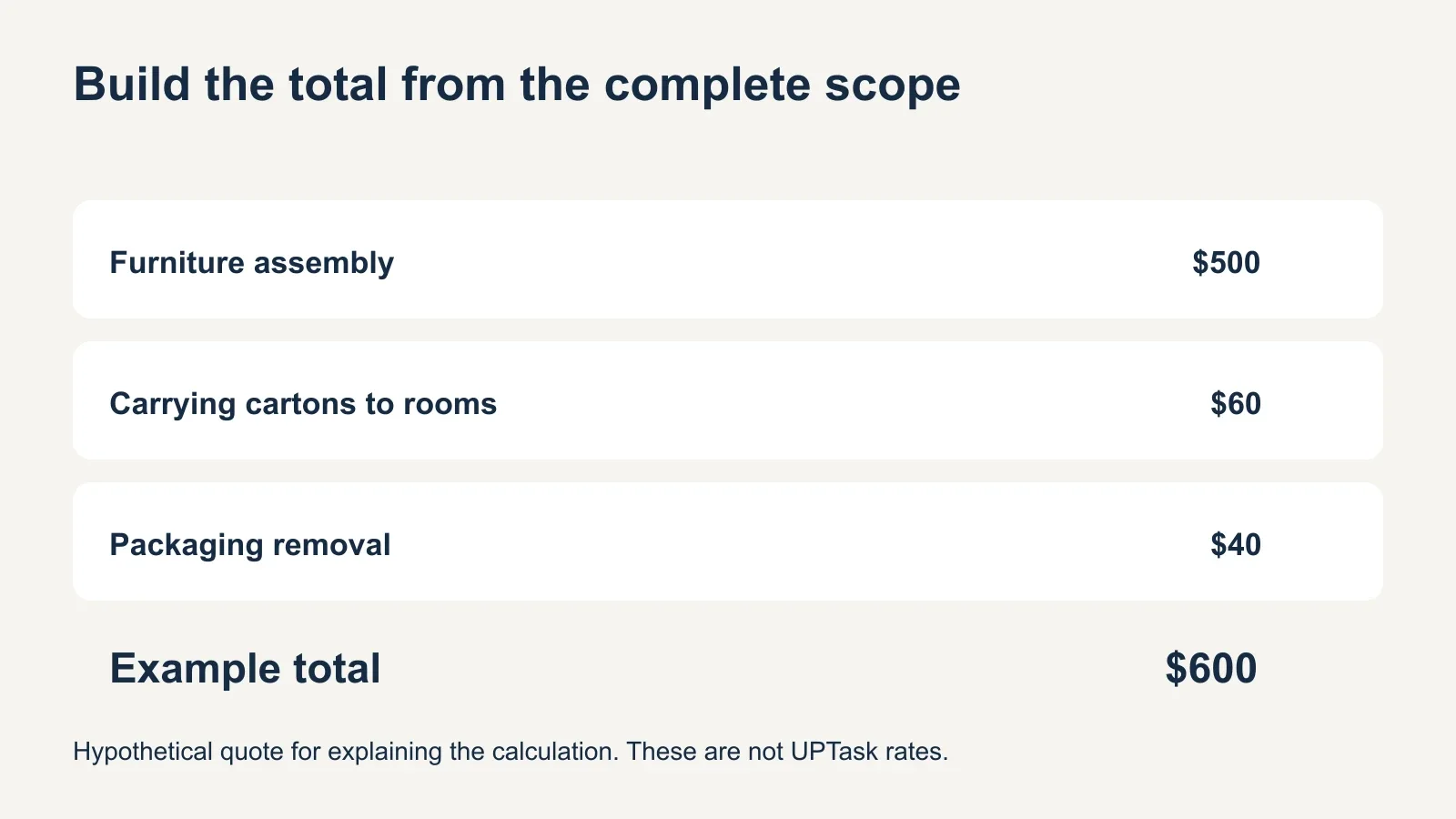
Now suppose the same provider quotes $60 to carry the relevant cartons into their rooms and $40 to remove the packaging. The complete example becomes $500 + $60 + $40 = $600. Neither extra is a universal fee, and neither should be added if the agreed assembly price already includes that work. Ask for a description of each charge.
Adding another bedroom does not necessarily double this number. If its only new pieces are a $95 bed, a $110 dresser and a $40 nightstand at these invented rates, it adds $245. The assembly subtotal becomes $745 before revised extras. The calculation follows added work, rather than multiplying the apartment’s bedroom count by an arbitrary allowance.
Compare fixed quotes with hourly estimates fairly
A fixed quote should identify the exact items and the agreed completion scope. A price described only as “assemble apartment furniture” leaves too much open: it may omit a storage unit, count dining chairs differently or exclude a required installation step. Keep the inventory attached to the quote so both parties can refer to the same list.
An hourly estimate needs a rate, expected billable hours, minimum charge and crew size. Clarify whether the rate covers one worker or the whole crew, and how additional time is authorized. Travel, carrying or cleanup may affect the bill if they are included in paid time. Confirm the actual fee structure rather than assuming all providers calculate it the same way.
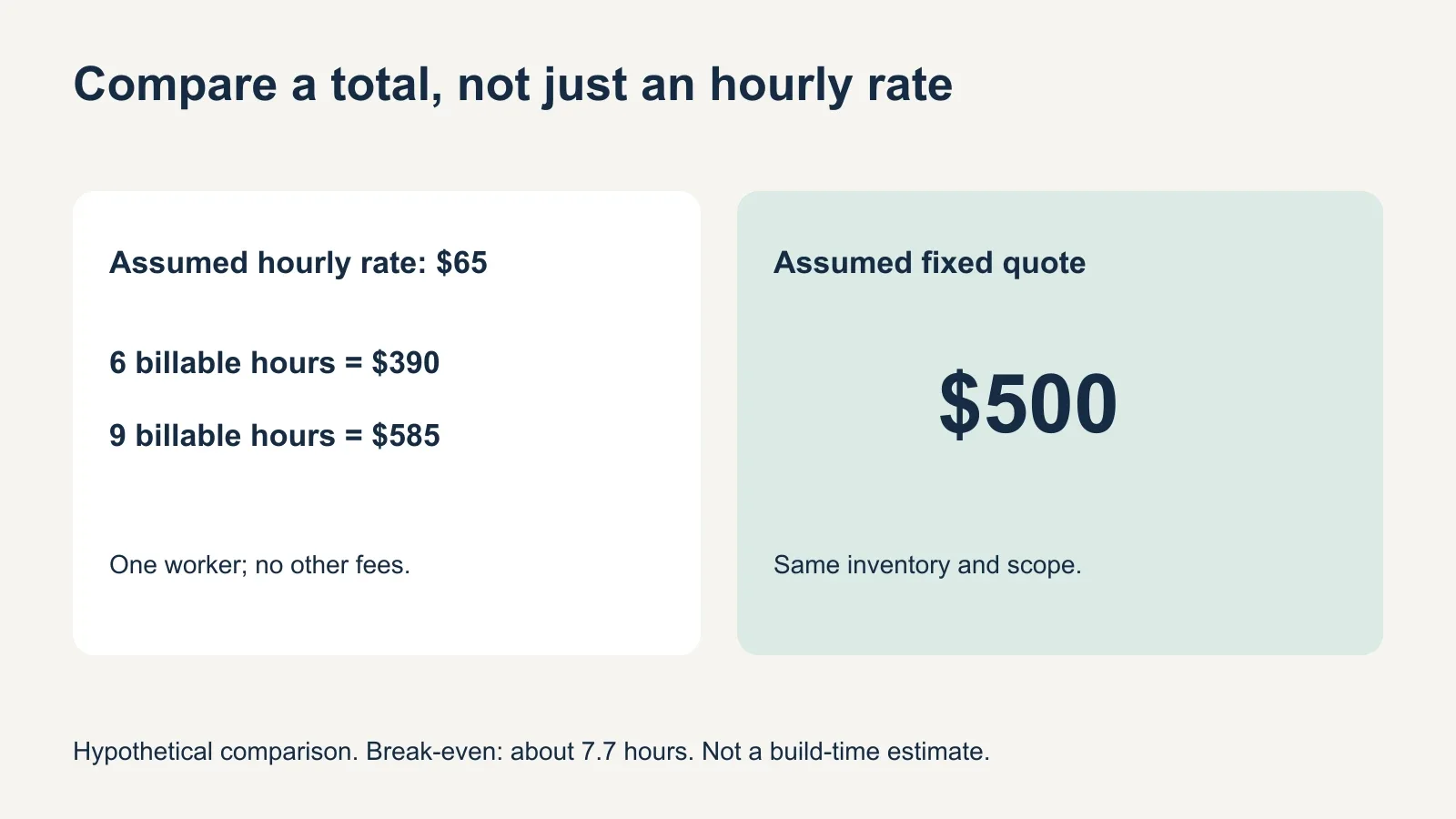
For a purely mathematical comparison, suppose a complete fixed assembly quote is $500 and an hourly alternative is $65 per billable hour for one worker, with equal scope and no other fees. The break-even point is $500 ÷ $65 = about 7.7 hours. Six hours would cost $390; nine would cost $585. These assumed hours are not an estimate of how long the eight-piece example takes.
For context, Taskrabbit’s U.S. cost guide, updated September 1, 2026, describes both hourly and flat-rate pricing and warns that access and workspace can affect the job. Its reported invoice averages cover a mixture of furniture tasks. A single-task average is not a quote for furnishing every room of an apartment, so avoid multiplying it by a guessed number of visits.
Check which services sit outside assembly
Delivery, carrying, furniture assembly and waste removal are separate outcomes unless a quote combines them. A truck reaching the building does not establish that cartons will be waiting beside the final bed position. Similarly, tidying the work area may mean gathering packaging, while off-site disposal means taking it away. Specify the outcome you need in ordinary language.
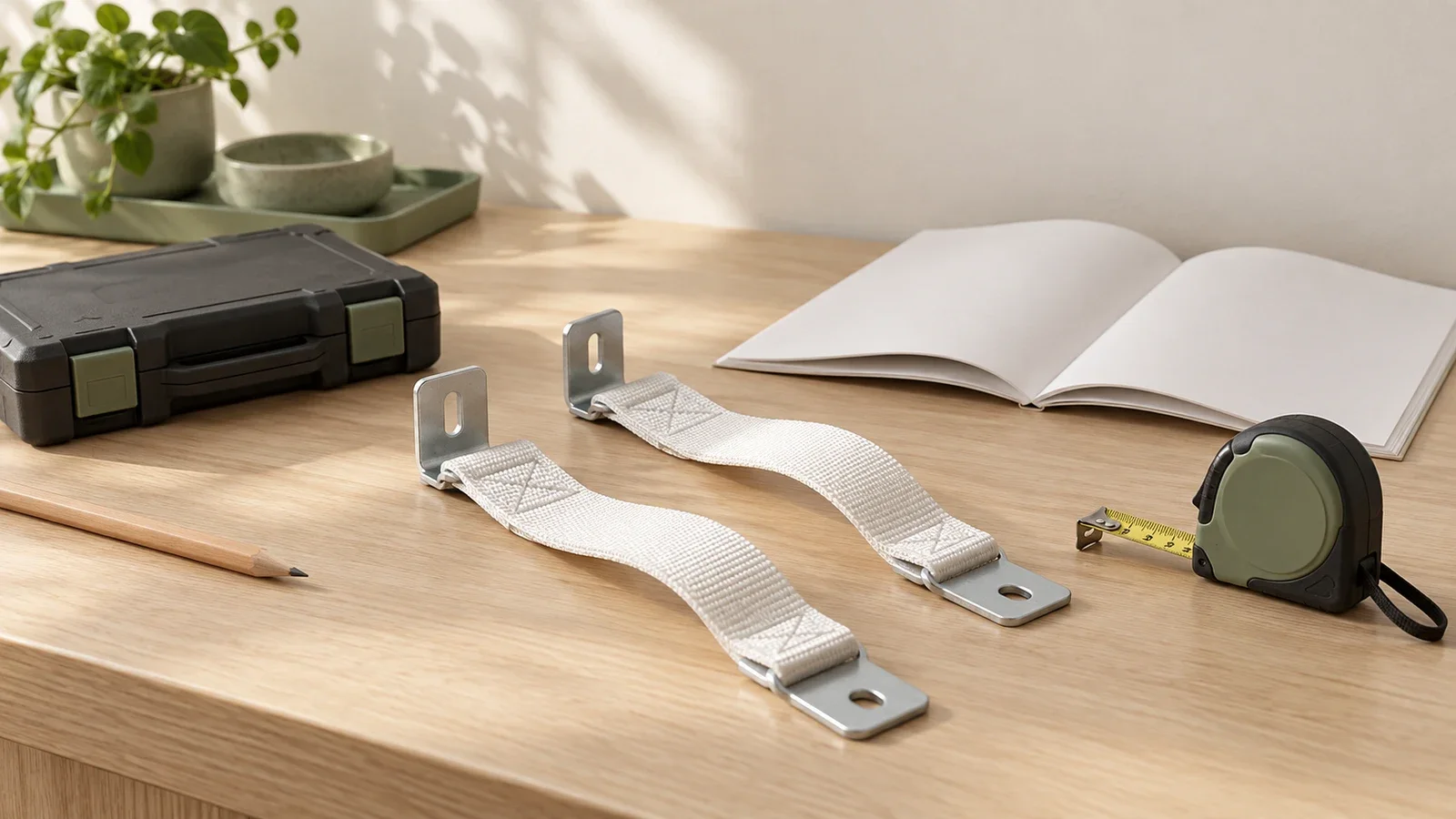
IKEA’s U.S. Assembly by Taskrabbit page provides a useful example of why scope matters: it requires packages in the final room and excludes packaging disposal, electrical work, plumbing, and kitchen and bath installation. It includes assembly to the instructions and tip-over restraints. Those are terms for that service, checked September 27, 2026; confirm each other provider’s terms independently.
For an apartment, describe the building arrangements before confirming the appointment. Mention stairs, the loading location, available elevator access and any management requirements you have actually been given. Do not promise access to a reserved loading area until it is arranged. The assembler needs a realistic route to the work area and enough time within the permitted access window.
Also distinguish furniture assembly from altering the apartment. Installing a supplied furniture restraint, mounting a television and modifying a wall are different tasks. Identify the manufacturer’s required completion steps and obtain any necessary property permission. A budget should account for safe completion; it should never assume required attachments will simply be skipped.
Use verified local prices for the pieces you know
UPTask’s Bay Area pricing illustrates how a real item calculation works. As checked September 27, 2026, a standard bed starts at $69 online, and selecting Queen size adds $10. A plain Queen frame therefore calculates to $79, before storage features or extras. The base scope includes the supplied ordinary headboard, footboard and supports or slats.
The online dresser minimum is $89 for up to four drawers, plus $5 for each additional drawer. A six-drawer dresser calculates to $99, making the Queen frame and dresser $178 together before any additional selections. These two items are only part of an apartment inventory. The online saving is already included and must not be subtracted again.
Review the bed assembly service and dresser assembly service against the actual models. Configure the rest of your inventory through the furniture assembly category. Do not extend one service’s drawer allowance, carrying option or price to an unrelated furniture category.
Reduce avoidable visits without assuming a discount
Combine ready items when the provider can accommodate the complete list, but ask for the resulting total. A multi-item discount is not automatic. Fixed item prices might stay unchanged, while an hourly job may benefit from shared setup or fewer separate minimum charges. Count a saving only when the actual quote or booking confirms it.
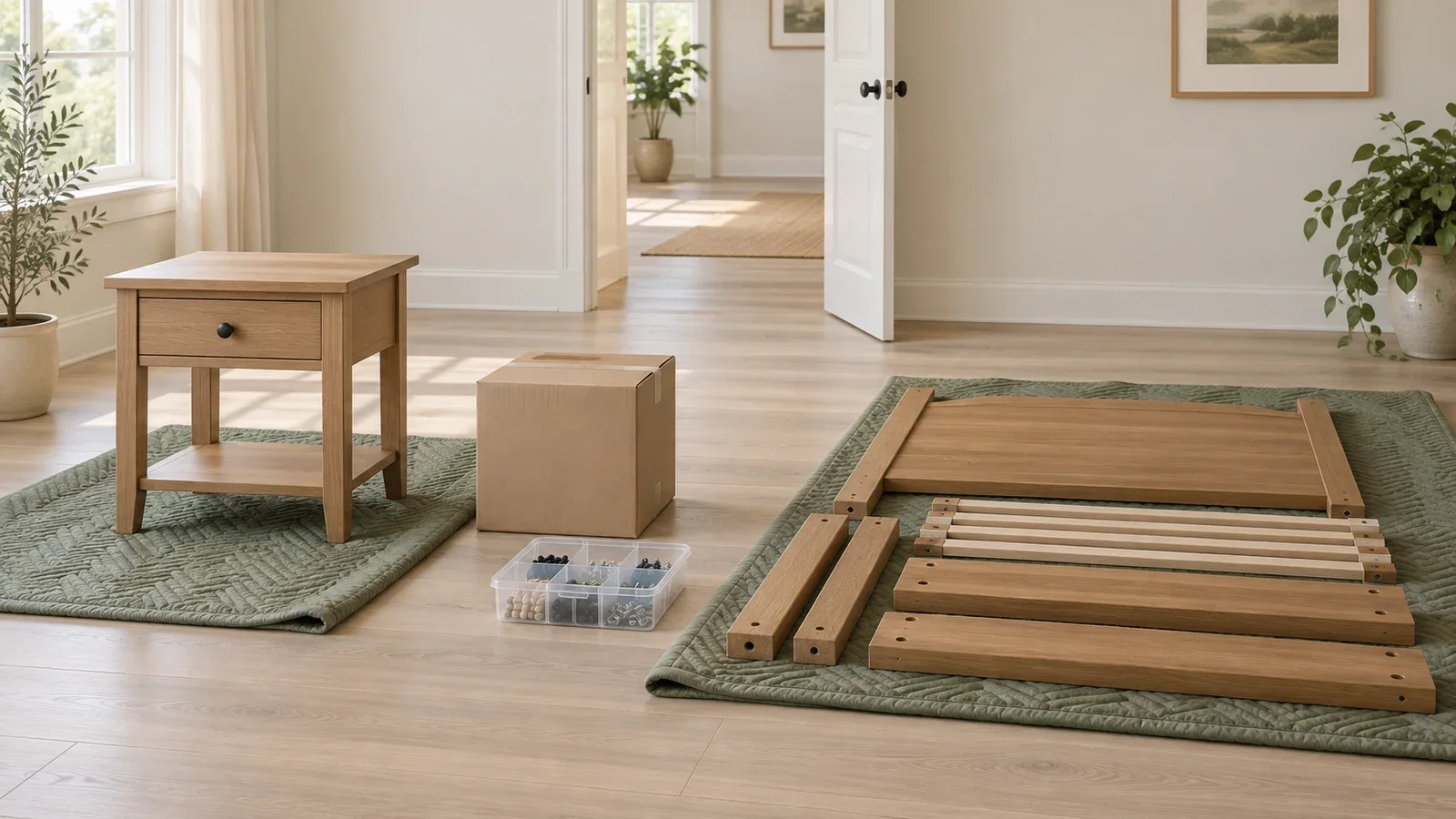
Check delivery completeness before scheduling a large build. Keep each furniture kit’s fittings and instructions with its own cartons, and flag visible damage or missing boxes. Opening all hardware bags into one shared container can make identification harder. Follow the provider’s preparation instructions and the manufacturer’s packaging guidance rather than taking everything apart in advance.
Decide which pieces are essential for the first night and which can wait if a delivery is delayed. Give the assembler your priority order, especially when access time is limited. A partially delivered wardrobe should not stop discussion of whether the complete bed and desk can be assembled under a revised scope. Agree on any price or scheduling changes first.
Send one complete brief to each provider
- List every furniture model, selected variation and quantity.
- Identify drawers, doors, storage, mechanisms and modular components.
- State the delivery status and whether any assembly has been started.
- Describe the final rooms, stairs, elevator and building access arrangements.
- Specify carrying, required attachment and removal needs.
- Ask for the total, pricing method, exclusions and change conditions.
- Compare the written responses against the same inventory.
The useful answer to “How much for the whole apartment?” is a price tied to a complete list. Build that list, replace example figures with current quotes, and compare the same finished result. For broader context on pricing methods and item complexity, see the furniture assembly cost guide.