Buying Used IKEA Furniture: How to Decide If It Is Worth It
Inspect the exact item, confirm the parts and price the entire move. A low asking price is only the beginning of the comparison.
Table of contents
Identify the exact item before arranging pickupSeparate cosmetic wear from damage that changes the decisionConfirm the parts and instructions before you payPrice the complete purchase, not only the listingPlan how it will leave the seller’s home and enter yoursUse a final buy, clarify or pass checklist
Used IKEA furniture can be worth buying when the exact item is identifiable, complete, in sound condition and practical to move. Compare the ready-to-use total, including transport, needed parts and assembly, with a comparable new option. A low asking price is less useful if you cannot confirm the condition of the joints, obtain an essential component or install the furniture as its instructions require.
Identify the exact item before arranging pickup
Ask for the product name, dimensions and a clear photograph of the article label, if it remains attached. Similar-looking products can use different parts across sizes and generations. A seller’s description of “an IKEA white dresser” is not enough to choose instructions, order hardware or check a recall. Match the label and physical details to the actual model.
Ask whether the furniture has been moved, disassembled, repaired or modified. A painted finish is not automatically a problem, but it can hide the original surface and make damage harder to assess. Extra holes, cut panels, replacement legs or added trim may mean the standard assembly instructions no longer describe the whole item.
Before buying, check the exact model against current IKEA U.S. product recalls and any applicable safety notices. If you find a match, follow the manufacturer’s remedy process instead of treating the listing as an ordinary bargain. Do not assume a furniture name absent from the seller’s description means the item is unaffected; resolve the identification first.
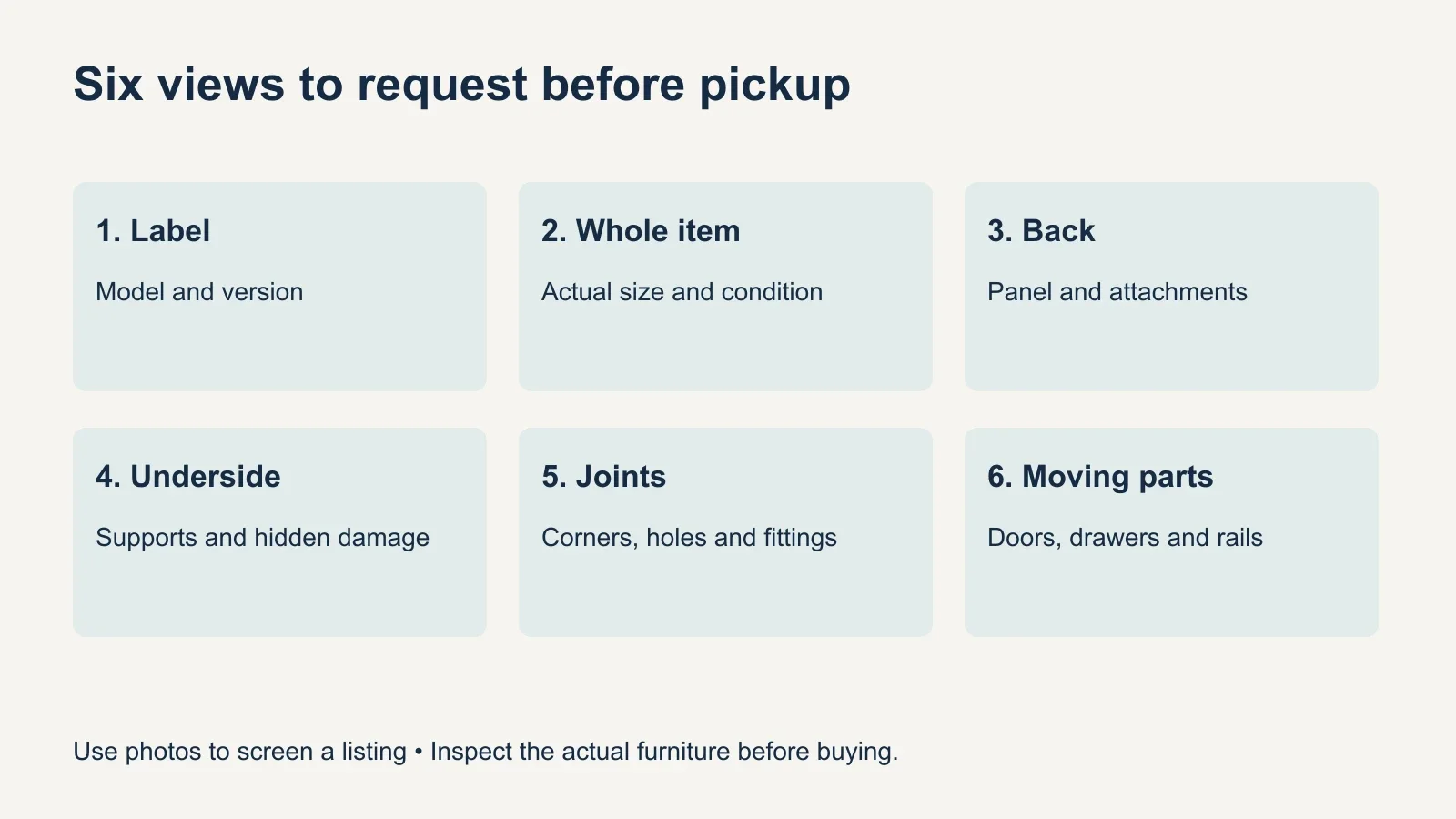
Request fresh photographs of the entire item, its back, underside, corners and attachment points. Include drawer interiors or door hinges when relevant. A single polished front view cannot show a swollen back edge or a damaged screw hole. If the seller cannot provide access to important areas, treat those areas as unverified when making your decision.
Separate cosmetic wear from damage that changes the decision
A shallow surface scratch can be acceptable if you like the price and appearance. Damage where panels, rails, legs or hinges connect matters more because it may affect assembly and use. Inspect the actual unit before committing; a photograph can help screen a listing, but it cannot establish that a connection is secure.
| Observation | Question to resolve | Buying decision |
|---|---|---|
| Light surface scratch away from a joint | Can you accept the appearance without a promised repair? | May be a cosmetic trade-off. |
| Swelling or flaking at an edge | Has moisture affected the panel or nearby fasteners? | Pause; do not budget it as simple paint touch-up. |
| Cracked panel or enlarged fastening hole | Can the correct component be replaced and assembled properly? | Pass if a sound repair cannot be confirmed. |
| Missing back panel, rail, hinge or hardware | What does the exact manual require, and is the part obtainable? | Confirm the replacement before paying. |
| Drawer or door does not operate normally | Is this damage, an assembly problem or a model-specific safety feature? | Identify the cause; do not force the mechanism. |
Look for separation at corners, loose joints, bowed shelves, damaged drawer tracks and evidence of water exposure. Do not ask the seller to demonstrate strength by climbing, sitting or pulling on furniture in a way it was not designed for. If normal operation looks unstable, stop the demonstration and have the condition assessed.
For furniture that requires wall attachment, a freestanding demonstration does not establish safe use. Ask to see the unit operating in its correctly installed condition when possible. If it has already been detached for pickup, rely on identification, component inspection and the correct installation plan rather than opening multiple loaded drawers to test it.
Confirm the parts and instructions before you pay
Use the manual for the exact version to identify the major panels, supports and hardware. A bag of assorted screws is not proof of a complete set. Ask the seller to keep hardware grouped by location and to include brackets, rails and other small components that may have been removed during disassembly.
Separate an ordinary replaceable fastener from a missing panel or specialized mechanism. Availability, compatibility and lead time can differ. As checked in November 2026, IKEA U.S. directs customers to a store coworker for spare-parts help while its online ordering system is unavailable. That does not guarantee that an older product’s particular panel or fitting can be supplied.
Before counting a replacement as a small expense, identify its part number and confirm the correct replacement route. The IKEA missing-parts guide explains how to distinguish small hardware from larger components. Avoid buying on the assumption that a currently sold hinge, drawer slide or door will fit every older piece with the same product-family name.
Wall attachment hardware needs its own check. The furniture may include its original bracket, but the fastener used in the seller’s wall may not suit yours. Confirm the required furniture-side components and plan the wall-side fixing for your home. See the guide to furniture that needs wall anchoring before making installation an afterthought.
Price the complete purchase, not only the listing
Add the asking price, transport, confirmed replacement parts, assembly and any other agreed costs. Include taxes or fees where they apply to your actual transaction. Compare that with the full cost of a suitable new item in the same usable condition, including delivery and any assembly you would buy for that option. Comparing used pickup with new delivered-and-assembled pricing without adjustment can be misleading.
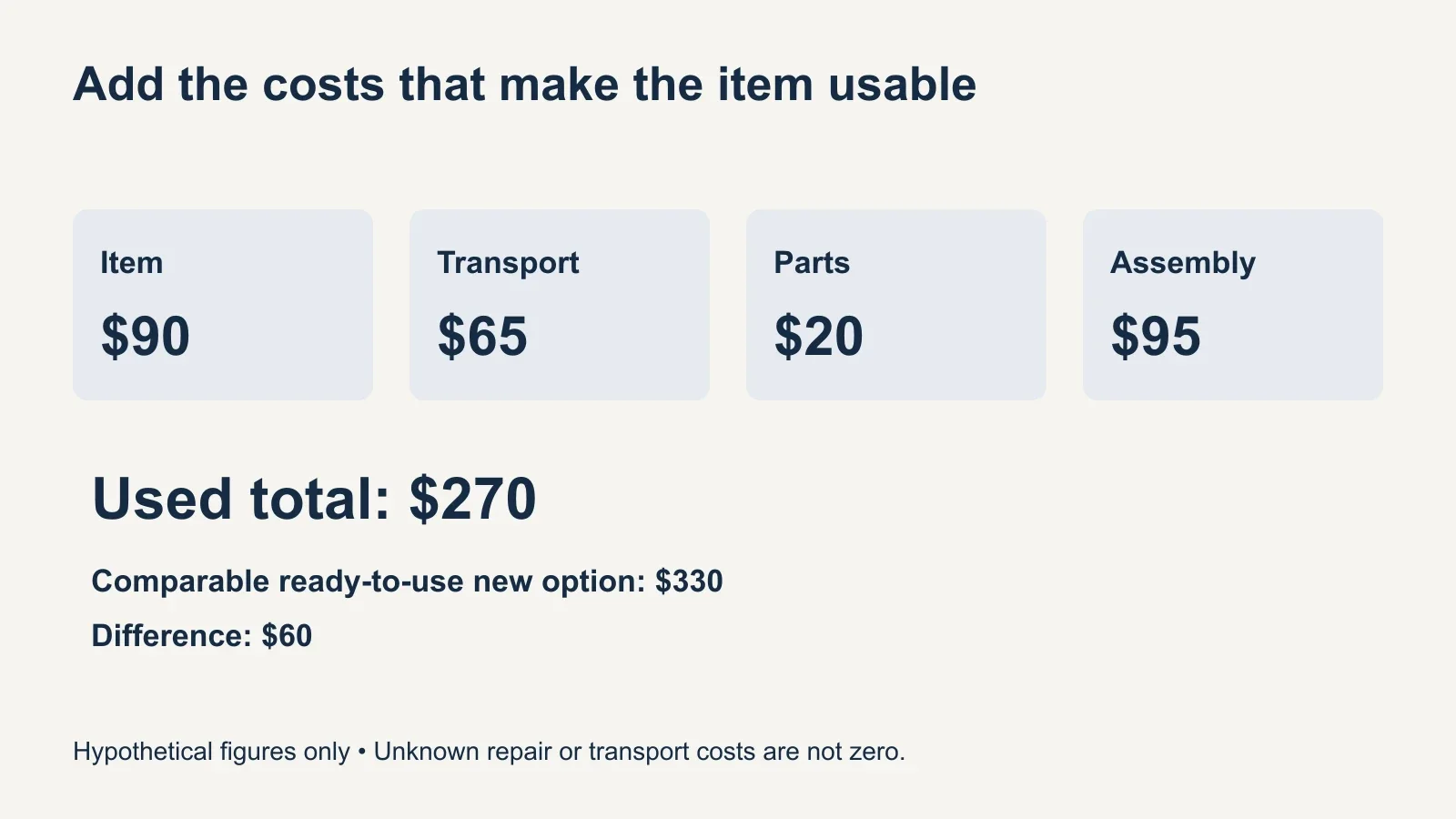
Consider this hypothetical comparison: a used cabinet costs $90, transport is $65, confirmed parts cost $20 and assembly is $95. The total is $270. If a comparable new cabinet would cost $330 ready to use under the same assumptions, the used option saves $60. These are invented planning figures, not IKEA prices, UPTask rates or market averages.
Now suppose a required panel is unavailable, or the carrier cannot confirm that the cabinet fits the stairs. The answer is not to assign that unknown a zero-dollar cost. Leave the comparison incomplete until you have a workable plan. A slightly cheaper total cannot compensate for an unresolved condition that prevents the item from being used properly.
Consider your time and tolerance for visible wear as well. You might accept a cosmetic scratch to obtain a discontinued size that fits your room particularly well. Conversely, several trips for parts may outweigh a modest saving. Make that preference explicit rather than pretending every used purchase needs the same percentage discount to be worthwhile.
Plan how it will leave the seller’s home and enter yours
Measure the assembled item and the transport route at both ends. Include stairs, landings, elevators and tight turns, not just the widest doorway. Confirm who is responsible for disassembly, carrying, loading and unloading. “Pickup available” does not tell you whether the seller will help move a large piece or whether the carrier will take it upstairs.
Decide whether disassembly is appropriate for this particular construction and condition. Repeated removal of hardware from a damaged fastening point may create problems, while transporting a large assembled unit can stress its joints or make the route impossible. Use the guide to disassembling furniture before moving to frame the decision, then check the actual item.
Before anything comes apart, photograph the assembly and label corresponding components. Protect finished surfaces and retain the manual and labeled hardware. Arrange suitable lifting help; do not drag a loaded cabinet by a door, tabletop overhang or unsupported panel. If a move requires a repair or modification first, settle that scope before paying for transport.
Also check the destination. The chosen wall, baseboard, floor and available assembly space must work with the unit’s instructions. Furniture that fitted perfectly in the seller’s alcove may not fit yours. A successful pickup is only one stage of getting a usable item into your room.
Use a final buy, clarify or pass checklist
- Confirm identity and review current recalls or safety notices for that model.
- Inspect the actual condition, including joints and normally hidden surfaces.
- Match the components to the correct instructions and confirm essential replacements.
- Verify both transport routes and the plan for installation at home.
- Compare complete costs with a genuinely comparable alternative.
- Buy only when the remaining trade-offs are ones you understand and accept.
Choose “clarify” when one answer could change the decision, such as a missing part number or an uncertain elevator dimension. Choose “pass” when essential condition or installation questions remain unresolved, even if the seller is asking you to collect immediately. The most useful used-furniture bargain is one you can identify, move and put into service without relying on a chain of hopeful assumptions.