How Long Does It Take to Assemble a Bed Frame? By Bed Type
A simple frame and a storage or bunk bed need different schedules. Use model-specific examples and a preparation checklist to plan the full appointment.
Table of contents
Published assembly times by bed typeCount the assembly stages hidden in the product photoPlan for the whole visit, not only the frame buildDIY time and professional time are different estimatesTwo workers do not automatically cut the time in halfPrepare the room and parts before the appointmentAsk for a schedule based on your exact bed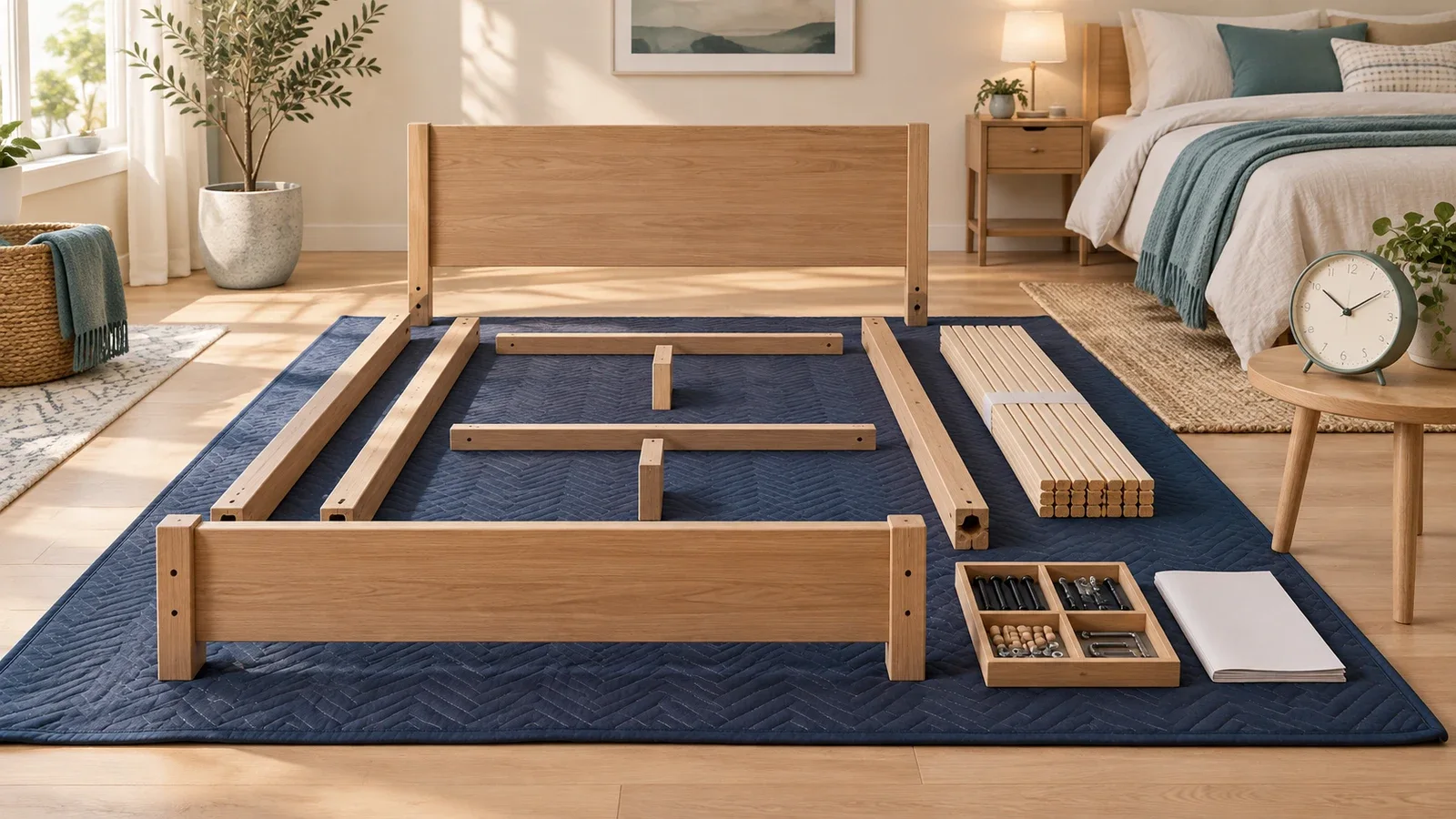
A standard bed frame may take roughly an hour for a professional, while a storage or bunk bed can need several hours. For a concrete reference, New York City provider Flat Rate Assembly lists 45–90 minutes for most frames and 90–120 minutes for drawer-storage beds. Those are that provider’s estimates, not universal times or UPTask guarantees. Your model, built-in features, room preparation and any old-bed work determine how useful a time estimate will be.
Published assembly times by bed type
The examples below were checked September 25, 2026. They come from two assembly providers and one manufacturer, so they are planning references with different scopes, not a single timing study. In particular, a manufacturer’s allowance for customers assembling its own product should not be compared directly with a professional’s estimate for a different bed.
| Bed or configuration | Published time | Who the estimate applies to |
|---|---|---|
| Most standard frames | 45–90 minutes | Flat Rate Assembly, NYC; professional service |
| Drawer-storage bed, such as BRIMNES | 90–120 minutes | Flat Rate Assembly, NYC; professional service |
| Standard twin-over-twin or twin-over-full bunk | About 2 hours | Next Phase Moving; professional service |
| Bunk with stairs, drawers or desk | 2–3 hours | Next Phase Moving; professional service |
| Adult loft bed | About 2 hours | AdultBunkBeds.com; its products, at least two people recommended |
| Adult bunk bed | 3–4 hours | AdultBunkBeds.com; its products, at least two people recommended |
A longer published allowance does not prove that a provider is slower or that a product is harder to build in every situation. Designs, included steps and the people doing the work differ. Use the closest matching example to identify the questions to ask, then confirm the expected duration for the exact bed you own.
There is no separate universal “Queen bed time” or “King bed time.” Size affects the space needed to handle components, but a plain King frame can have fewer assembly stages than a Twin storage bed. Product type and configuration are more useful starting points than mattress dimensions alone.
Count the assembly stages hidden in the product photo
A straightforward frame usually centers on joining the sides and ends, installing the specified supports, and fitting the slats or platform. A storage model adds separate units and moving parts. The finished product photo can conceal that extra work, especially when drawers are closed or bedding covers the frame.
- Drawers: count every box that must be built and fitted, including drawers inside a headboard.
- Storage headboard: identify shelving or compartments beyond an ordinary headboard.
- Trundle: include the second sleeping frame and its rollout components.
- Lift-up storage: identify the exact mechanism and confirm that the service accepts the model.
- Bunk or loft additions: list stairs, a desk, drawers and other integrated furniture.
These features should be described separately even when they arrive in the same shipment. “One bed” is a product count, not a complete description of the work. Avoid assigning a fixed number of extra minutes to each drawer without model-specific evidence; drawers and fittings are not standardized across furniture ranges.
For example, two Queen beds may take the same mattress but have very different builds. One has a perimeter frame, supports and ordinary headboard. The other adds four drawers and a storage headboard. An estimate made for the first configuration cannot reliably schedule the second, even though the size and number of beds are unchanged.
Plan for the whole visit, not only the frame build
The assembler needs access to the work area before assembly can proceed. If the old frame still occupies the bedroom or the new cartons are elsewhere, those tasks belong in the schedule. Ask whether the quoted duration covers only building the new furniture or also includes the preparation you need help with.
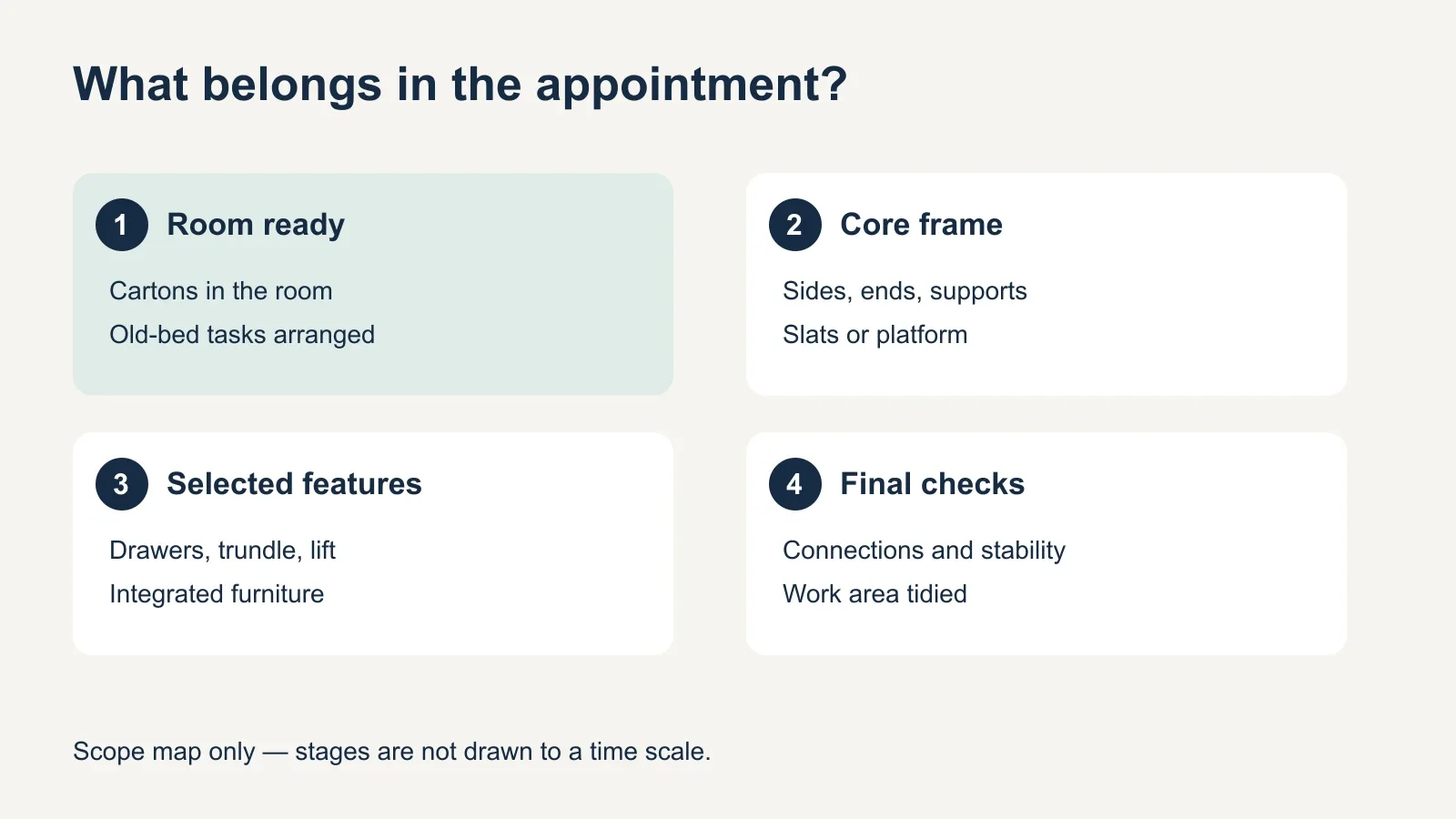
UPTask’s published bed-assembly scope includes the selected frame, its supplied supports or slats, an ordinary headboard and footboard, connection and stability checks, and tidying the work area. Applicable storage or integrated features need to be selected. Bringing cartons into the assembly room, disassembling an old bed and moving its dismantled pieces are separate options.
Moving dismantled furniture to another nearby location at the property is also different from taking it away for disposal. Specify which outcome you need. A schedule for assembling a boxed frame does not automatically include clearing the bedroom, hauling away furniture or resolving missing parts.
DIY time and professional time are different estimates
A professional’s published duration is not a reliable stopwatch target for a first attempt. Reading the instructions, identifying similar parts and becoming familiar with the fittings are part of DIY work. Use the manufacturer’s estimate for the exact model when one is available, and follow its stated number of people and assembly sequence.
AdultBunkBeds.com, for example, recommends at least two people for its assemblies and gives different time allowances for its loft and bunk beds. That recommendation belongs to those products; it does not establish a crew requirement for every bed on the market. Your own manual is the relevant guide for handling and assembly requirements.
Decide who will help before opening a large kit. If the instructions call for another person, arrange that assistance for the relevant steps rather than assuming the job can be done alone in the same time. A deadline is not a reason to omit supplied supports, guardrails or a required check.
For DIY planning, leave room in your schedule to stop and resolve an unclear instruction. If you discover a damaged component or missing hardware, contact the seller or manufacturer. Extra assembly time cannot replace an essential part, and a time-saving shortcut should not change the specified construction.
Two workers do not automatically cut the time in half
Some steps can happen at the same time, while others depend on earlier connections or require coordinated handling. The effect of an additional person therefore depends on the model and work sequence. Ask about the expected elapsed time for the planned crew instead of dividing a one-person estimate by two.
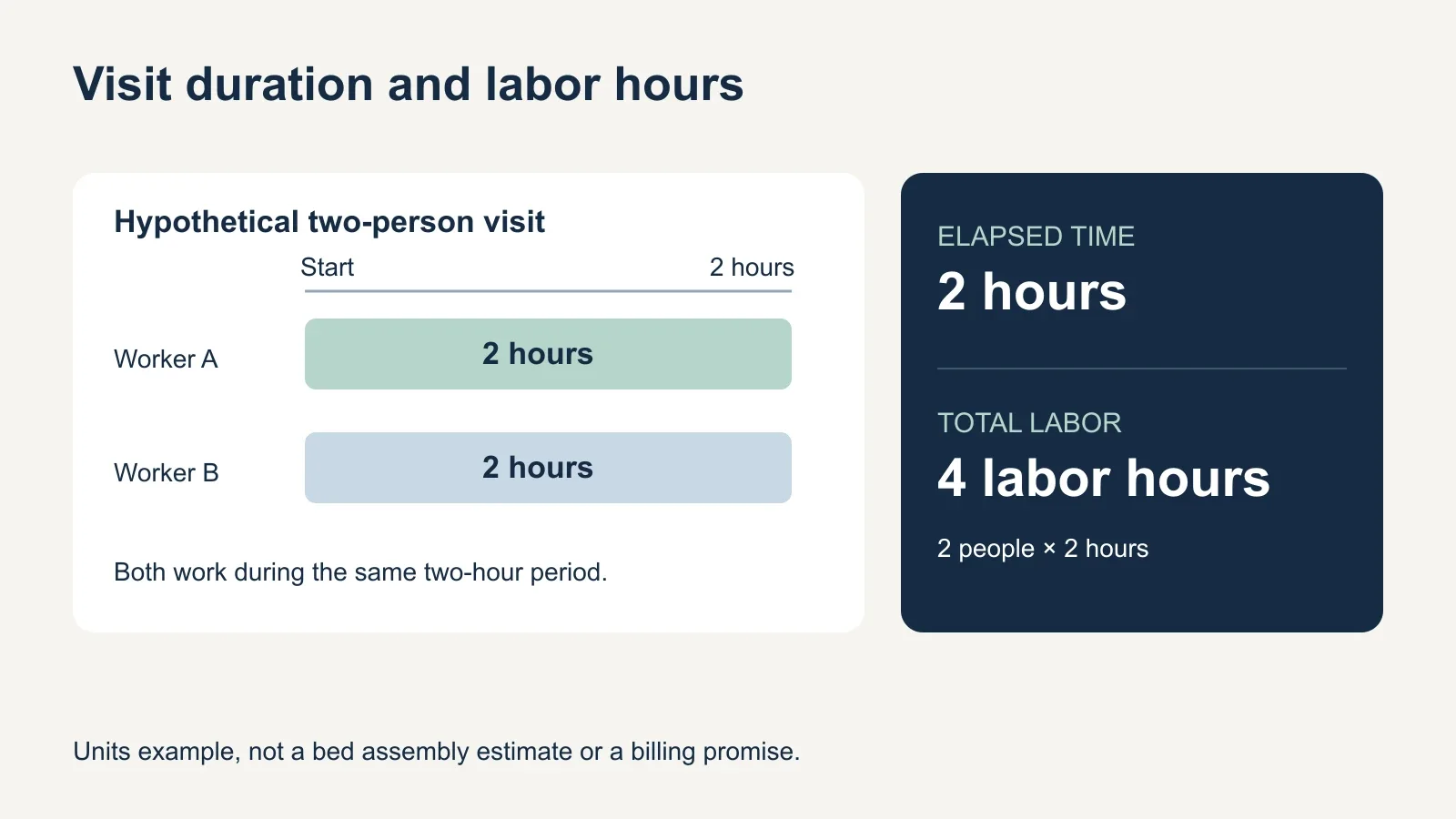
As a simple units example, two people working for two hours equals four labor hours during a two-hour visit. It does not mean that every bed takes two hours or that every service bills by combined labor hours. A fixed assembly price, a rate per worker and a rate for a crew are different arrangements.
When comparing hourly offers, confirm what the rate covers and whether there is a minimum billable period. The furniture assembly cost guide explains the broader pricing questions. For scheduling, focus on the expected visit length after the provider has seen the model and full scope.
Prepare the room and parts before the appointment
- Confirm the full delivery. Check the package count against the order and assembly instructions, including separately supplied storage components.
- Get the kit into the bedroom. Keep the instructions and hardware bags with it, or request carrying help when arranging the job.
- Make working space. Clear the bed location and enough surrounding floor space to lay out and handle parts as the manual requires.
- Resolve the old-bed plan. Arrange any dismantling and movement needed before the new frame can occupy the space.
- Flag problems early. Share photos of damaged packaging or parts and describe any known missing item before the visit.
Preparation helps the estimate describe actual assembly rather than avoidable uncertainty. It does not guarantee a shorter appointment: a complicated frame still requires its full assembly sequence. Keep hardware identifiable and the instructions accessible instead of mixing several furniture kits together on the floor.
If several items are being assembled, list them individually. A separate nightstand, dresser or desk in a bedroom-set photo is not automatically part of the bed build. The furniture assembly category lets you identify the other services needed for that room.
Ask for a schedule based on your exact bed
Send the product link or model number, mattress size, storage features and any integrated furniture. State whether all boxes are in the room and whether the old bed needs attention. If you need the room back by a particular time, explain that constraint before booking so the proposed appointment can be assessed against the actual work.
For a larger project, the furniture assembly time guide helps separate the different items in the schedule. For one Bay Area bed, use the UPTask bed assembly page to describe the correct frame and features, then confirm timing for that configuration. A model-based estimate is the useful next step after consulting general time ranges.