Does White Glove Delivery Include Assembly? What to Confirm
Check the actual scope behind the service name. Delivery, assembly, wall attachment and removal can belong to different appointments.
Table of contents
Translate the service name into specific tasksCompare two offers line by lineAsk where assembly ends and installation beginsConfirm access, room preparation and timingSeparate packaging cleanup from old-item removalGet a clear confirmation before the appointment
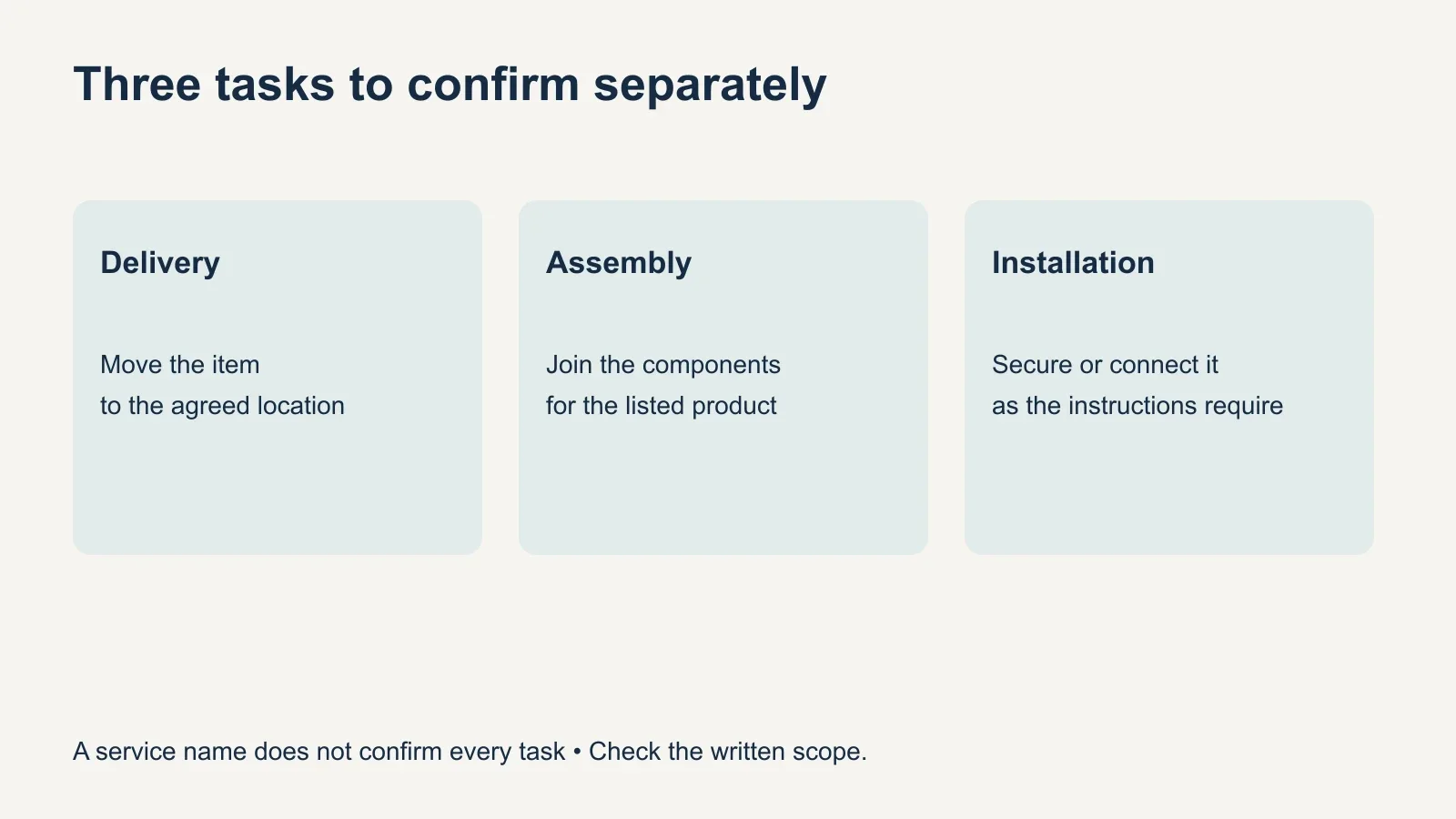
White glove delivery may include assembly, but the name alone does not confirm the work included in your order. Check the exact item, delivery option and written service scope. Room placement, unpacking, assembly, wall attachment, packaging removal and removal of old furniture are separate tasks. A service that handles some of them may exclude others, even when the furniture arrives inside your home.
Translate the service name into specific tasks
Start with the product page and the delivery option actually selected at checkout. A retailer may offer parcel delivery for one item and a more extensive truck service for another. The general shipping page is useful background, but the order confirmation should identify the service that applies to your purchase and address.
Separate delivery to the entrance from delivery to the room where the furniture will be used. Then separate unpacking from assembly. A sofa needing only feet attached and a wardrobe arriving in many flat-pack boxes can involve very different work. Ask whether the quoted assembly covers your specific model and all of the components you are ordering.
West Elm’s U.S. FAQ, for example, describes its Premium White Glove truck service as including room placement, unpacking and full assembly, while excluding installation. It also identifies exceptions, including smaller items shipped by parcel carrier and separate headboards that are not attached to an existing bed frame. Check the current item-specific terms rather than extending one example to every purchase.
A separately purchased assembly appointment has its own boundaries. IKEA’s U.S. assembly service through Taskrabbit, for example, does not include taking away the resulting packaging. The comparison is useful because it shows why buying “assembly” does not automatically settle the cleanup question. These retailer examples describe their services, not UPTask’s scope or a universal definition.
Compare two offers line by line
Create a short comparison before deciding that one quote is better value. Use the same product, delivery address, floor and room in both requests. If one provider assumes ground-floor placement while the other knows about two flights of stairs, their totals do not yet describe the same job.
| Task | Offer A: delivery package | Offer B: delivery plus assembler |
|---|---|---|
| Room placement | Included for the agreed room and route | Delivery stops at the entrance; room transfer unresolved |
| Unpacking | Included | Assembler expects boxes in the assembly room |
| Product assembly | Included for the listed item | Separate appointment for the listed item |
| Required wall attachment | Not confirmed | Included only after wall and hardware scope is confirmed |
| Packaging removal | Included | Not included |
| Old furniture removal | Excluded | Excluded |
| If boxes are missing | Ask how delivery completion is recorded | Ask about rescheduling the assembly visit |
Offer B is incomplete until someone is responsible for getting the cartons into the correct room. Offer A is incomplete if the item requires wall attachment and no one has agreed to perform it. Neither offer solves the old-furniture problem. The lesson is to close those gaps before comparing the final price, rather than assume the more reassuring service name covers them.
Request an itemized total or a clear written statement of inclusions and exclusions. Check whether stairs, parking, difficult access, extra labor or a return visit can change the charge. There is no need to invent a typical white glove surcharge: the useful number is the amount for your actual item and conditions.
If assembly will be booked separately, use the furniture assembly cost guide to understand which details affect a quote. Do not add two advertised starting prices and treat the sum as a confirmed total when delivery access or assembly scope remains unresolved.
Ask where assembly ends and installation begins
Assembly generally refers to putting the furniture’s supplied components together. Installation may also involve securing the finished item to a wall or another surface. The words can be used differently by providers, so name the actual operation: attaching a wardrobe to the wall, fixing a cabinet rail or connecting a powered feature.
If the furniture instructions require wall attachment, plan for that requirement before booking. A provider’s exclusion does not make the manufacturer’s attachment step optional. Confirm whether the provider performs it, who supplies suitable wall fasteners and what information is needed about the wall. If another professional must do it, agree on the sequence and keep the furniture out of use until required work is complete.
IKEA’s U.S. terms for assembly through Taskrabbit require instructed wall attachment and exclude work such as modifying the product, altering molding, plumbing and electrical work. That is one specific service boundary. Ask any provider about your actual baseboard, wall or connection issue instead of assuming a paid assembly visit includes changes to the room.
A useful request is: “The instructions require this item to be attached to the wall. Does your price include that step for this wall type, including the necessary hardware, or do I need a separate appointment?” Provide the product details and clear photographs. Our guide to which furniture needs wall anchoring explains why this question belongs before first use.
Confirm access, room preparation and timing
Give the delivery provider the details that affect the route: entrance type, stairs, landings, elevator dimensions and any tight turn. Confirm whether the furniture travels in cartons or already assembled and compare the relevant dimensions with that route. A spacious final room cannot compensate for a turn the item cannot negotiate on the way there.
Check building requirements before choosing a date. Ask management about elevator reservations, delivery windows, loading access and any requested insurance paperwork. Then confirm with the actual delivery or assembly provider how those requirements will be met. Do not wait until the crew arrives to discover that the elevator reservation belongs to a different time window.
Prepare a working area, not just a final furniture footprint. Move personal belongings and make the agreed route accessible. Confirm who moves existing furniture; delivery and assembly crews may exclude that task. The guide to space needed for furniture assembly helps distinguish the finished footprint from the room needed to handle panels and parts.
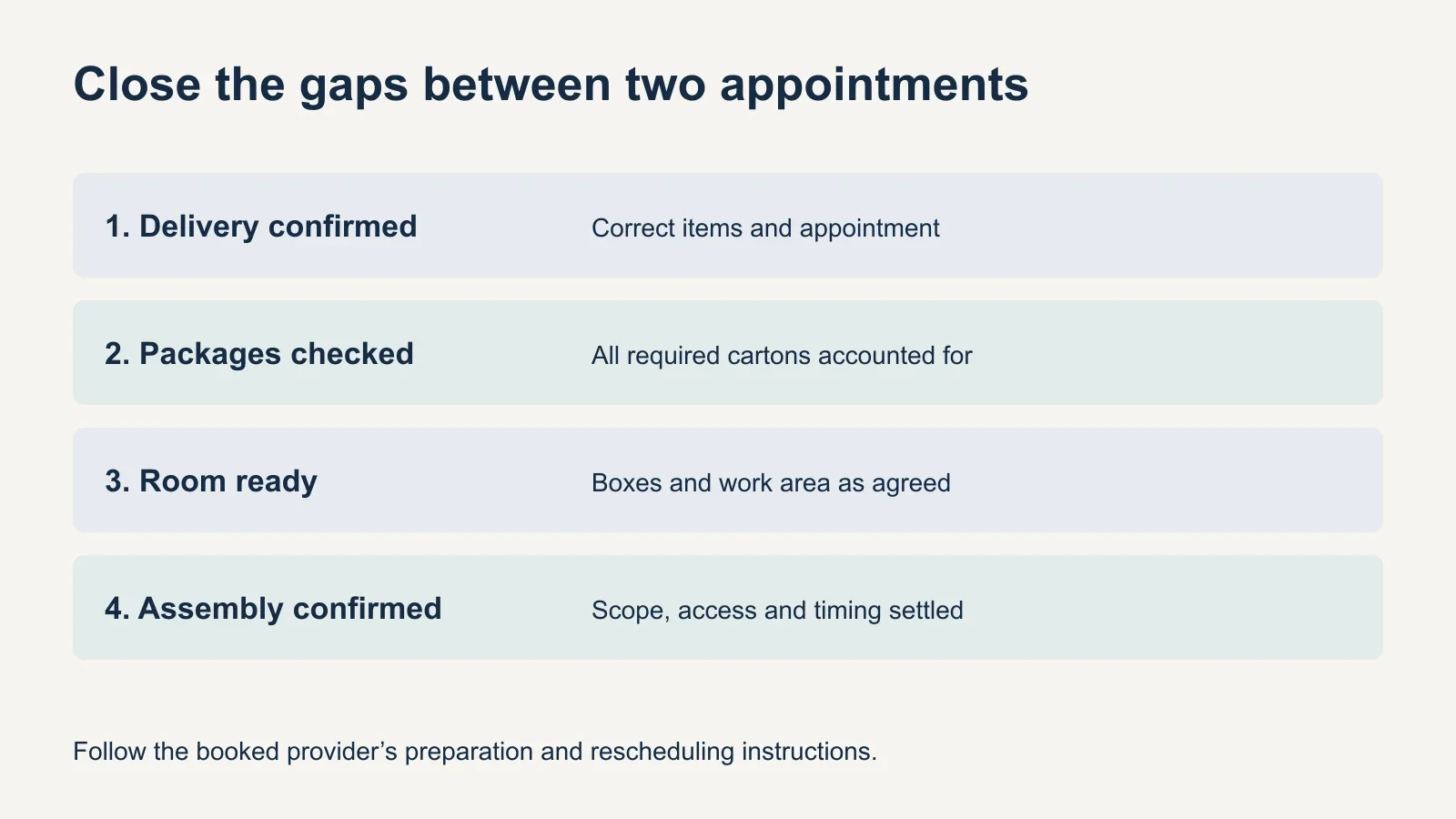
If delivery and assembly are separate, avoid treating an estimated delivery day as a guarantee that every carton will be ready for an immediate assembly appointment. Confirm the delivery, check that the required packages have arrived and follow the assembler’s preparation instructions. Ask how a delay or damaged component affects the appointment and any rescheduling charges.
Separate packaging cleanup from old-item removal
Ask what “cleanup” means. It could mean collecting loose packing material in one place, taking cartons to your building’s designated area, or removing them from the property. Those outcomes require different arrangements. Confirm whether the service removes all packaging and whether your building allows the proposed disposal method.
Old-item removal is another task. Taking away cardboard from a new table does not necessarily include dismantling and removing the previous table. Describe the old item, location and condition, then confirm the destination and charge if removal is offered. Arrange this separately when it is excluded, especially if the old item blocks the installation area.
Before discarding packaging yourself, follow the retailer’s instructions for checking condition and reporting missing parts. Keep labels, hardware and instructions organized until the contents are accounted for. If you notice damage, document it and contact the responsible service using the order’s reporting process rather than continue assembly in the hope that the defect will disappear.
Get a clear confirmation before the appointment
- Identify every product and component included in the delivery and assembly scope.
- Name the destination room, floor and agreed access route.
- Confirm unpacking, assembly, required attachment and any separately arranged work.
- Specify where packaging and old furniture will go, and who handles each.
- Confirm the total, possible extra charges and the process for delays or missing packages.
- Keep the order confirmation and the provider’s written answers together.
Before the team leaves, review the completed work against that agreed list. Check that the correct items reached the correct room, the agreed components were assembled and any required attachment within the booked scope was completed. Report omissions or damage through the provider’s process and keep a record of unresolved items. A precise scope gives you something concrete to check; the phrase “white glove” by itself does not.